Folk Tales (Uncle John & Uncle Jim)

“The past is not dead.  It’s not even past.” ~ William Faulkner

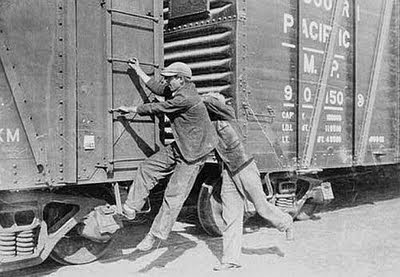
Jumping a train.
In Mr. Burl’s folk tale below, “Uncle Jim” and “Uncle John” hop a train to Mt. Sterling.

Folk and fairy tales have always been a source of fascination to me.  As a child, I couldn’t get enough of Hansel and Gretel, Red Riding Hood, Rapunzel and all of those beloved classics.  As an adult, I carried that interest with me into some scholastic pursuits, studying, for instance, the history of those age old stories while trying to understand what they mean in our collective consciousness. 

Folk tales  hold an especially important place in local communities.  Children can learn moral lessons from them and they can act to enforce social norms.  But, and perhaps most wonderfully, they work to help us define a sense of place, and we all need that, no matter how far we roam. 

Mr. Burl had a few Bath County folk tales he liked to tell and what follows is one of them.  “Uncle Jim” and “Uncle John” are completely fictitious, by the way. ~Ginger

From the journals:

It is probably true that tales, whether true or not, are told and ever handed down from generation to generation.  The author has heard some local tales many times and with a little different twist each time.

Do you remember the one about the two good old boys who loved to jump the freight train and ride to Mt. Sterling for special events?  On some of their visits they imbibed in a few “snorts.” One day, before hopping the freight to Mt. Sterling, they heard that there was a “mad dog” in the community.*  While in town, they had a few “snorts” and attended a circus.  After leaving the circus, they went down to the tracks to hitch a ride home.  Upon reaching the jump off place which was up a grade, they jumped off and started walking through the woods.  Suddenly they met a dog.  Remembering  the news they had heard prior to leaving home that morning, Uncle John climbed a nice big tree nearby, while Uncle Jim unfortunately scrambled up a sapling..  As he was trying to climb out of reach of the dog the sapling began bending over until Uncle Jim was almost back on the ground.  

Uncle Jim being very frightened called to Uncle John and said, “What do I do now?”  

Uncle John hollered back, “Turn her loose and climb her again!”

*In Mr. Burl’s notes, he mentions “mad dog scares” and writes that he wants to ask Dr. Bobby Byron how rabies was treated before the vaccine.  I don’t guess he ever had that chance, but it sure would have made for interesting reading.  I’m assuming there was no cure, and any treatment would have pretty much been regarded as futile.  
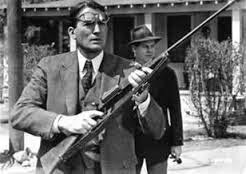
Atticus Finch protects the town from a mad dog in To Kill a Mockingbird, surprising his children with his skill with a gun.   I thought of this scene when I read Mr. Burl’s note on mad dog scares.  
Don’t we all just love Atticus?

“It was times like these when I thought my father, who hated guns and had never been to any wars, was the bravest man who ever lived.” ~ Harper Lee, To Kill a Mockingbird


May Day

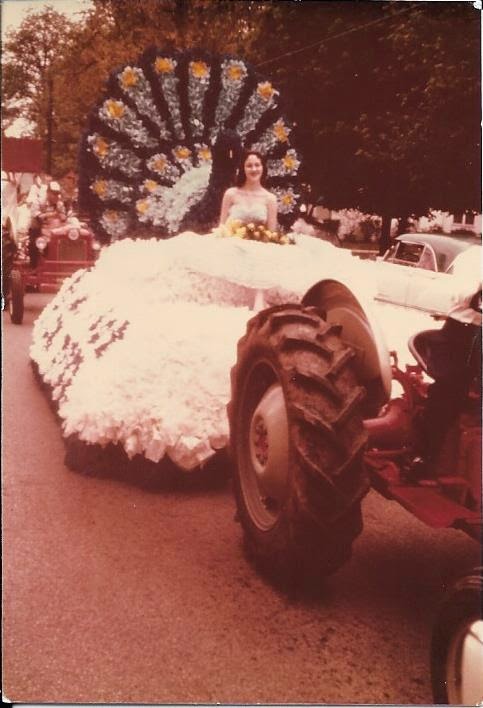
A May Day float, pulled by a tractor.

Floats were often “pomped” by stuffing tissue paper or dinner napkins in chicken wire.  Evidently, cardboard and glue are used more frequently now.


Last year, I asked my youngest son, Boone, if he was coming in from college for May Day (our annual spring festival here in Bath County, for those of you who aren’t familiar).  He rolled his eyes and said, “No.  I’m staying as far away from Owingsville as I can on that day.”
Well, he made it home just before the parade started.  “I thought you weren’t coming in,” I teased.
“I forgot it was May Day,” he replied, with just a hint of a grin.
He hadn’t forgotten.  We sat down on our front porch and watched the parade together, waving at participants, admiring the floats, pointing out people we knew, and both of us smiling from ear to ear.    
I’m betting Mr. Burl was smiling when he wrote this piece.  We hope it makes you smile, too.  Happy May Day, everybody! ~ Ginger
From the journals:
The courthouse clock strikes 1:00 P.M.  Hundreds of people line Main Street anxiously awaiting the parade that by some fellas is the number one event of the year in Bath County.  Older folks are greeting old friends, making new ones, and generally having a great day.  Children are squirting water guns, often spraying spectators and parade participants.  Camera bugs are all set at vantage positions to make keepsake photos. 
There are concession stands in front and to the sides of the courthouse.  They are broiling steaks and hamburgers out in front.  Parking spaces are gobbled up early and some people are forced to park a half mile distance from the center of town.
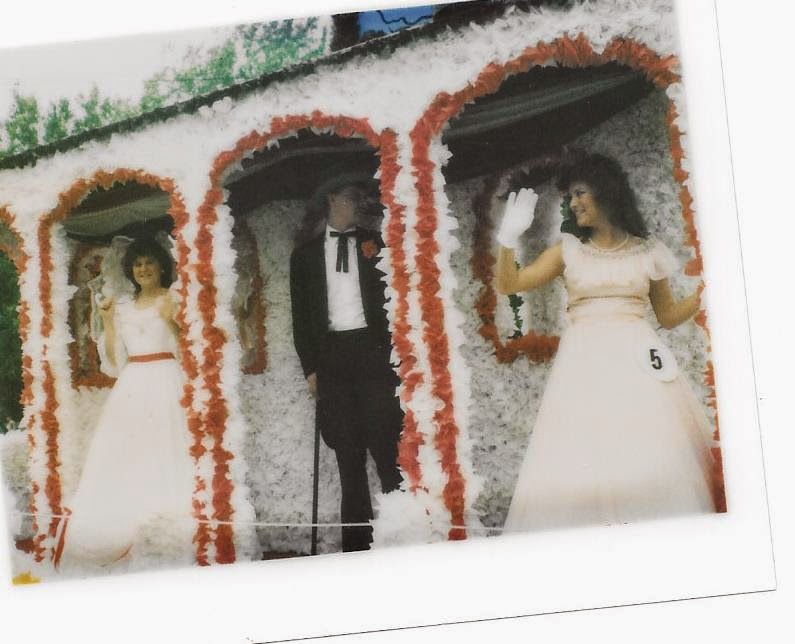
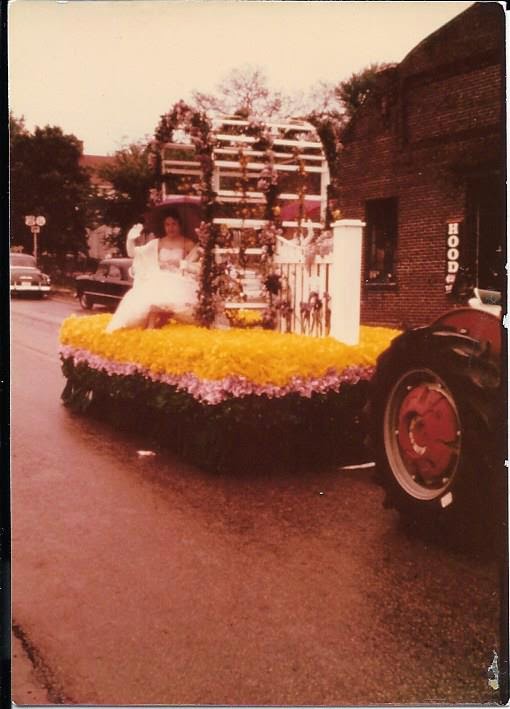
May Day!  May Day! – No, these words do not signal an emergency – they signal the parade is approaching!  Color guard, class A and B floats, antique cars, clowns, horses, miniature cars, queen candidates, calliopes, bands, antique hearses, fire trucks, DES vehicles, Boy Scouts, and farm tractors – these are all part of our May Day parade.

In front of what is now Marley Clark’s garage. 


The would-be May Day avoider, Joseph Boone Kincaid (grandson of William Burl Kincaid, Jr.)
His grandfather would approve of the fishing, but not that Dodger’s cap.


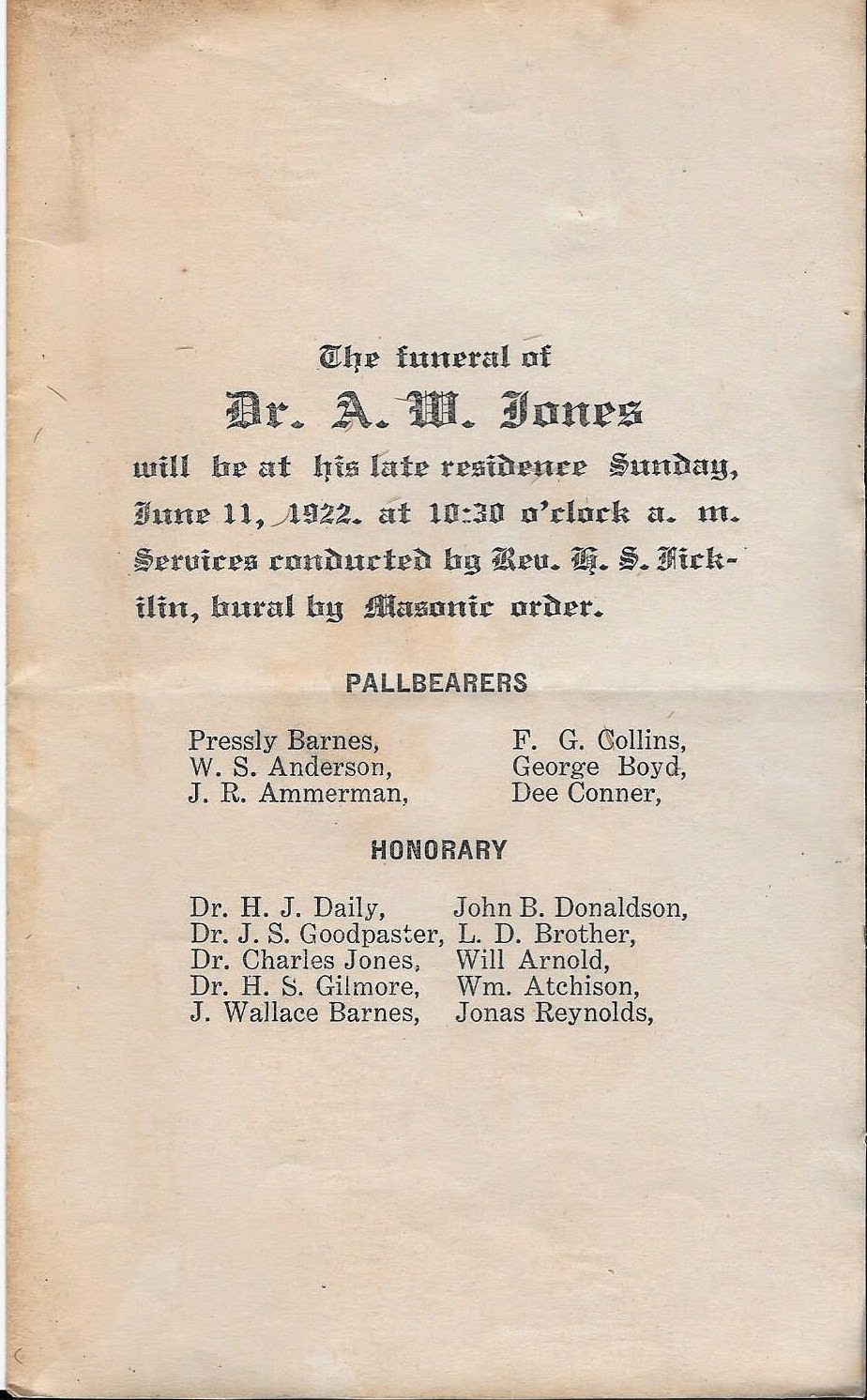
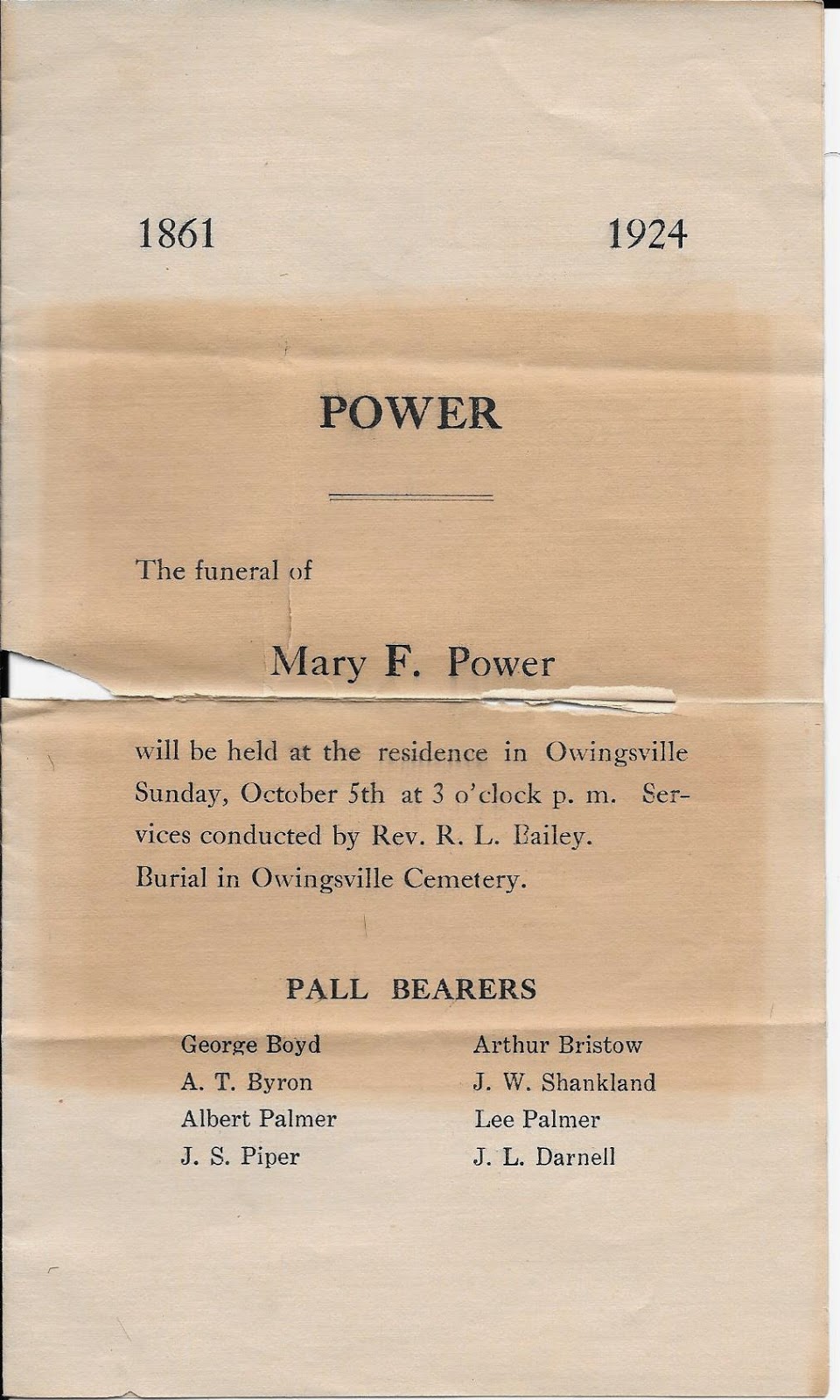
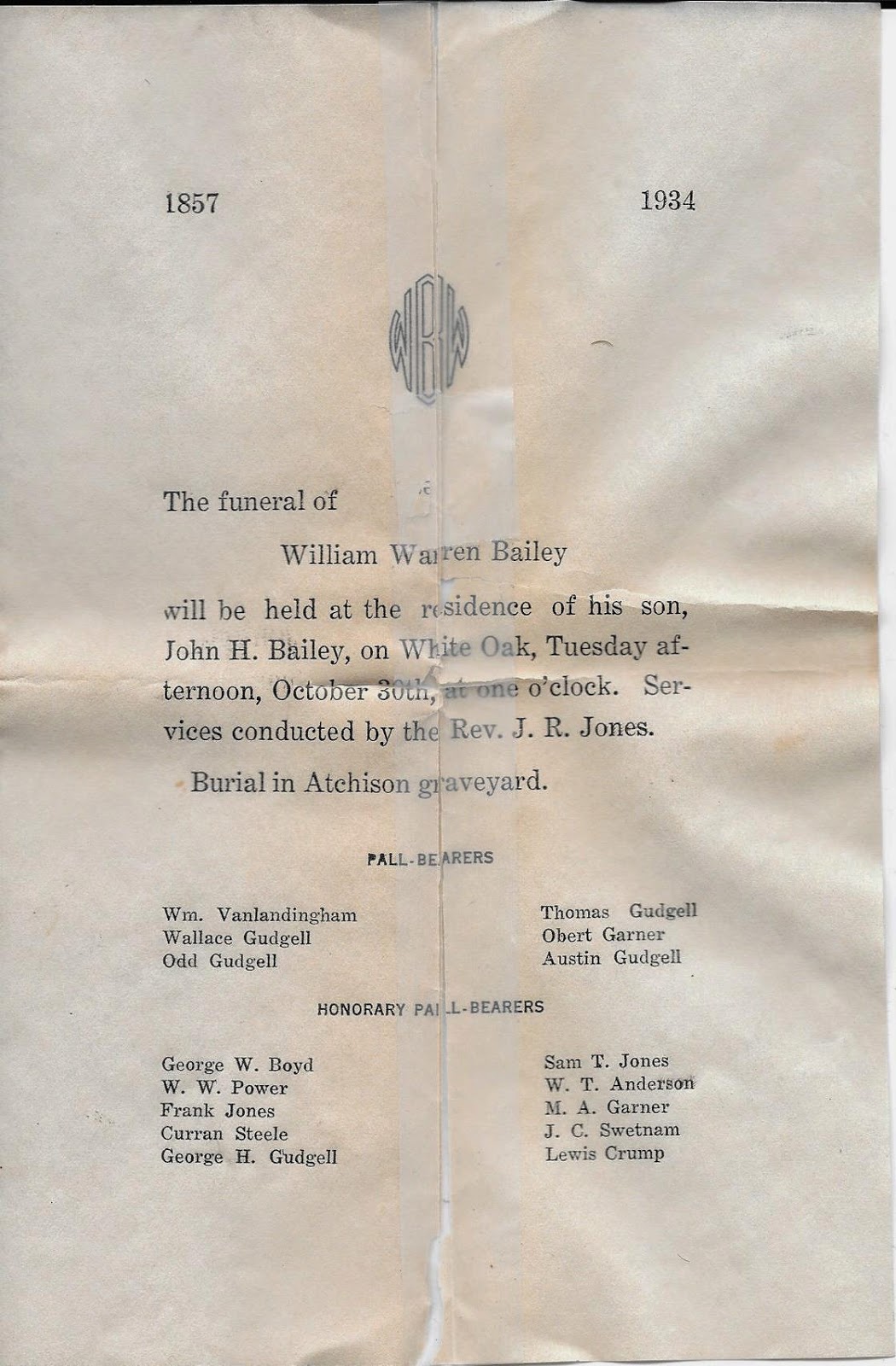
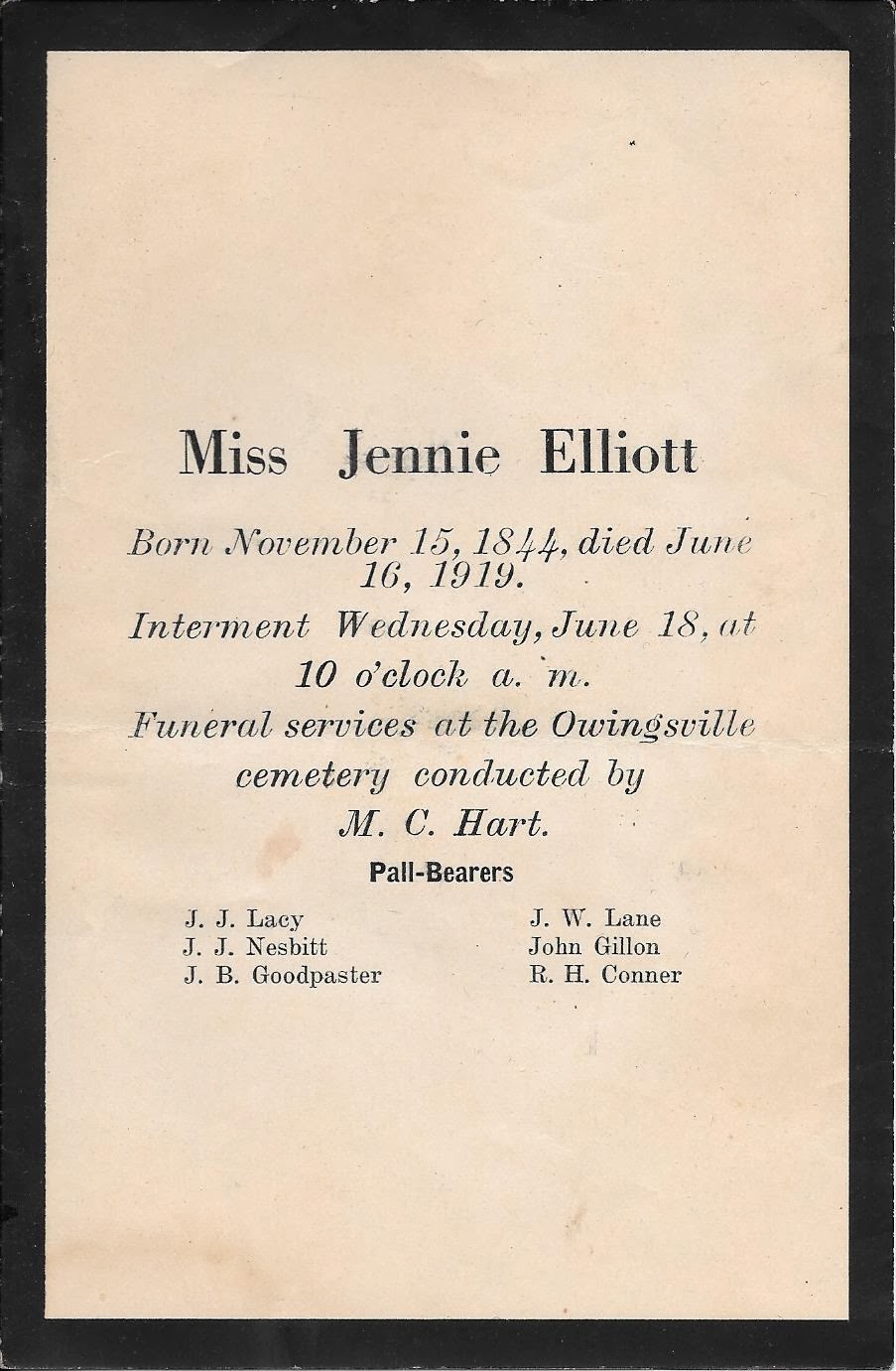
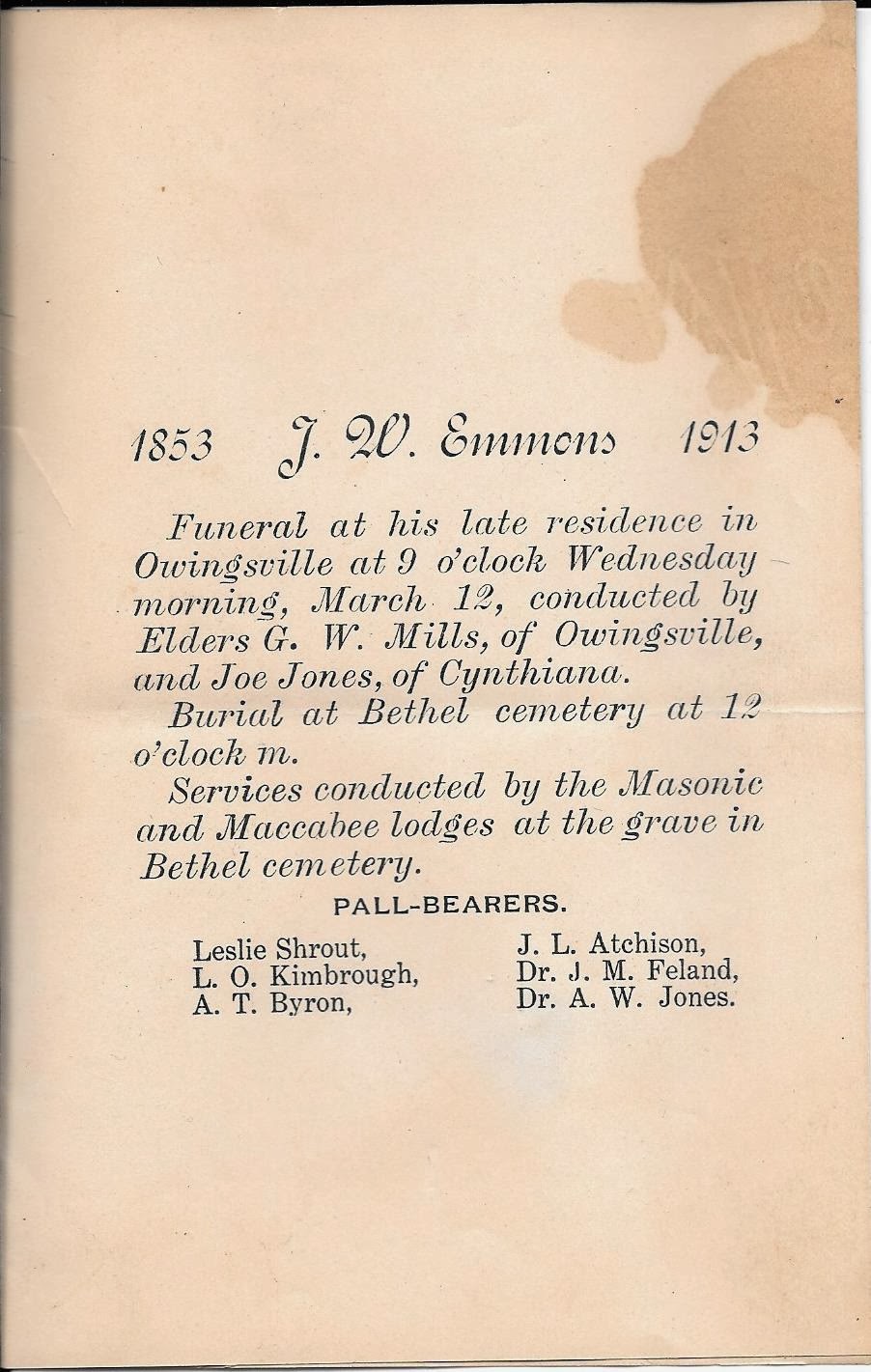
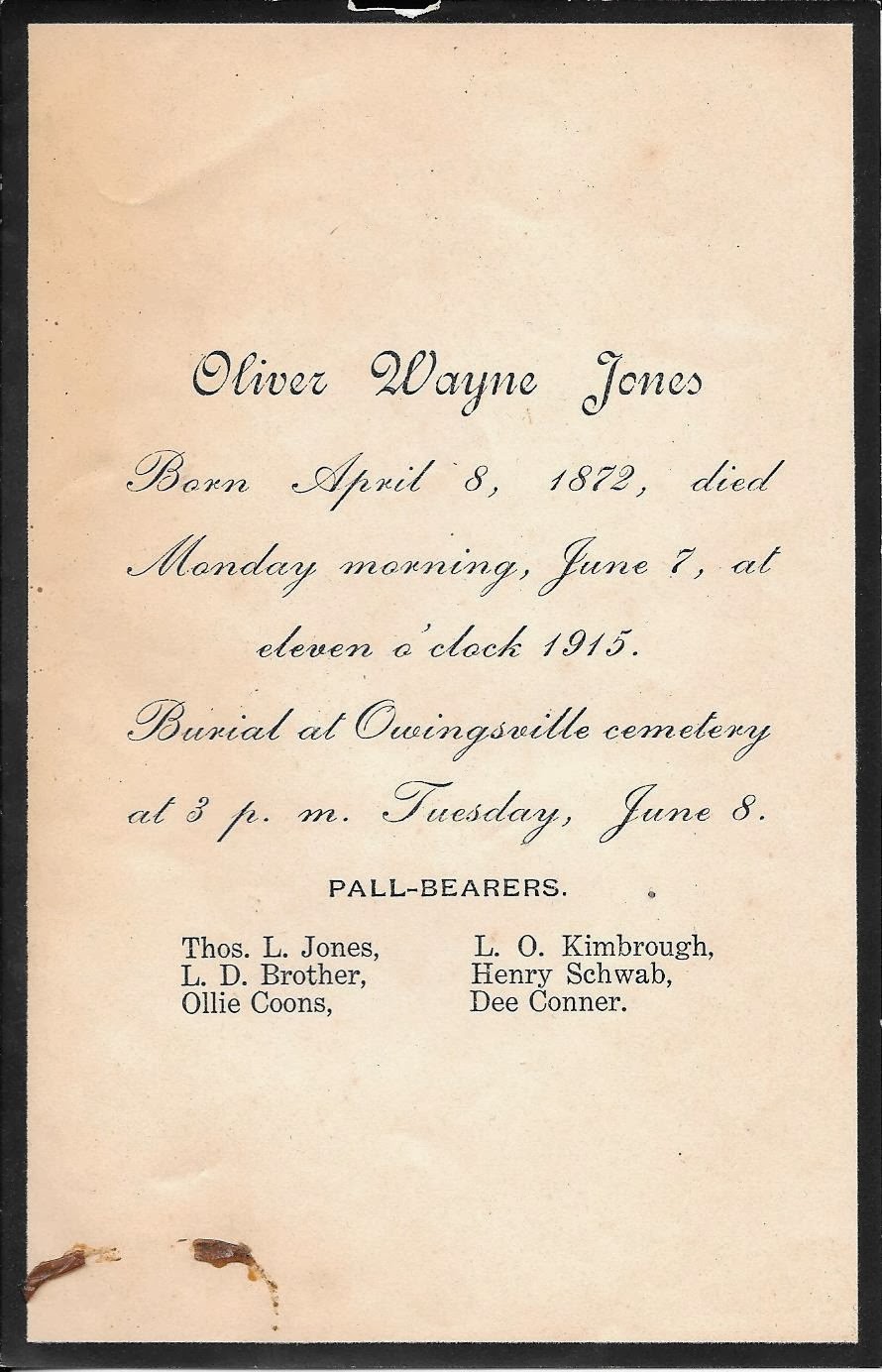
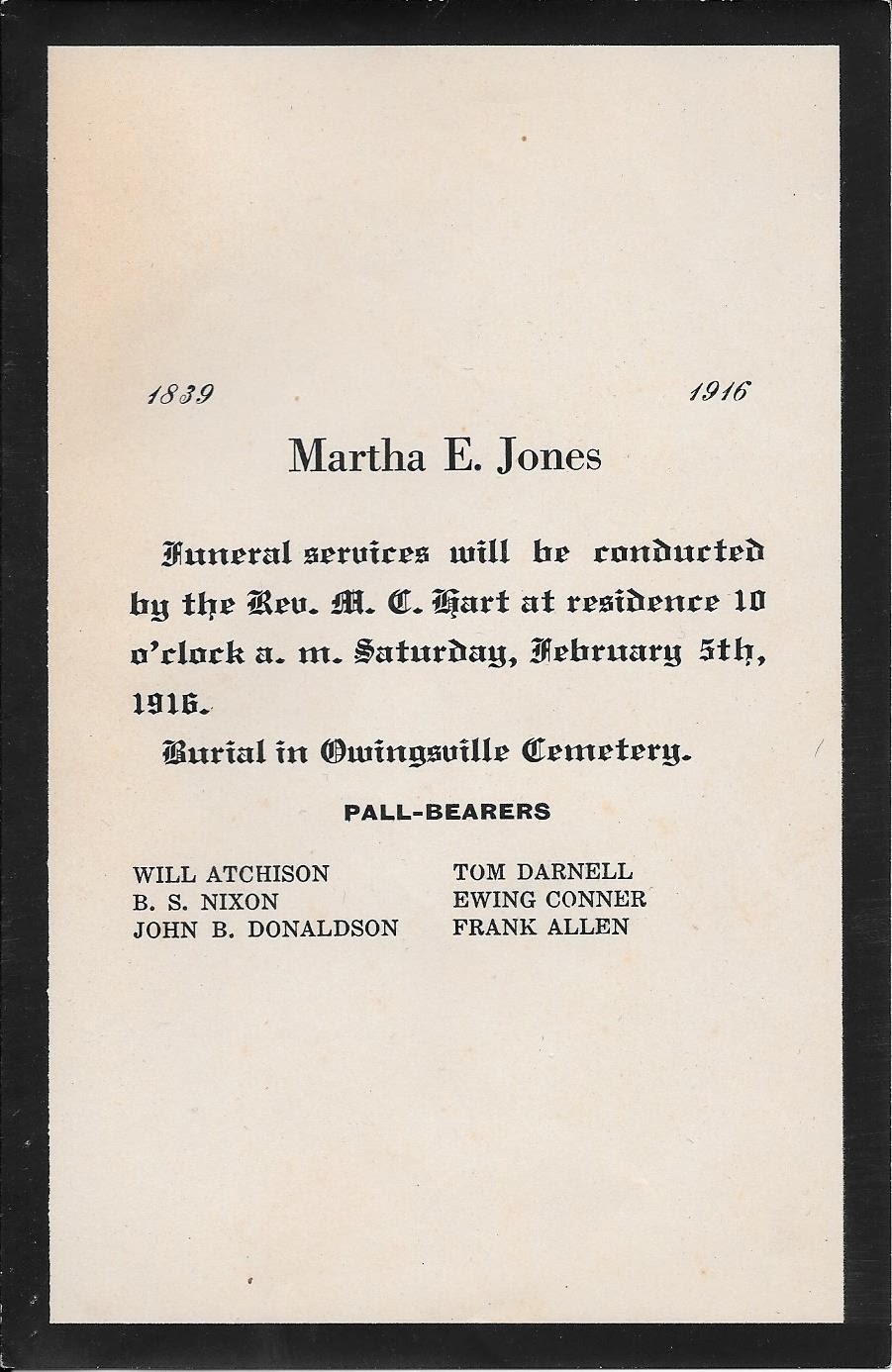
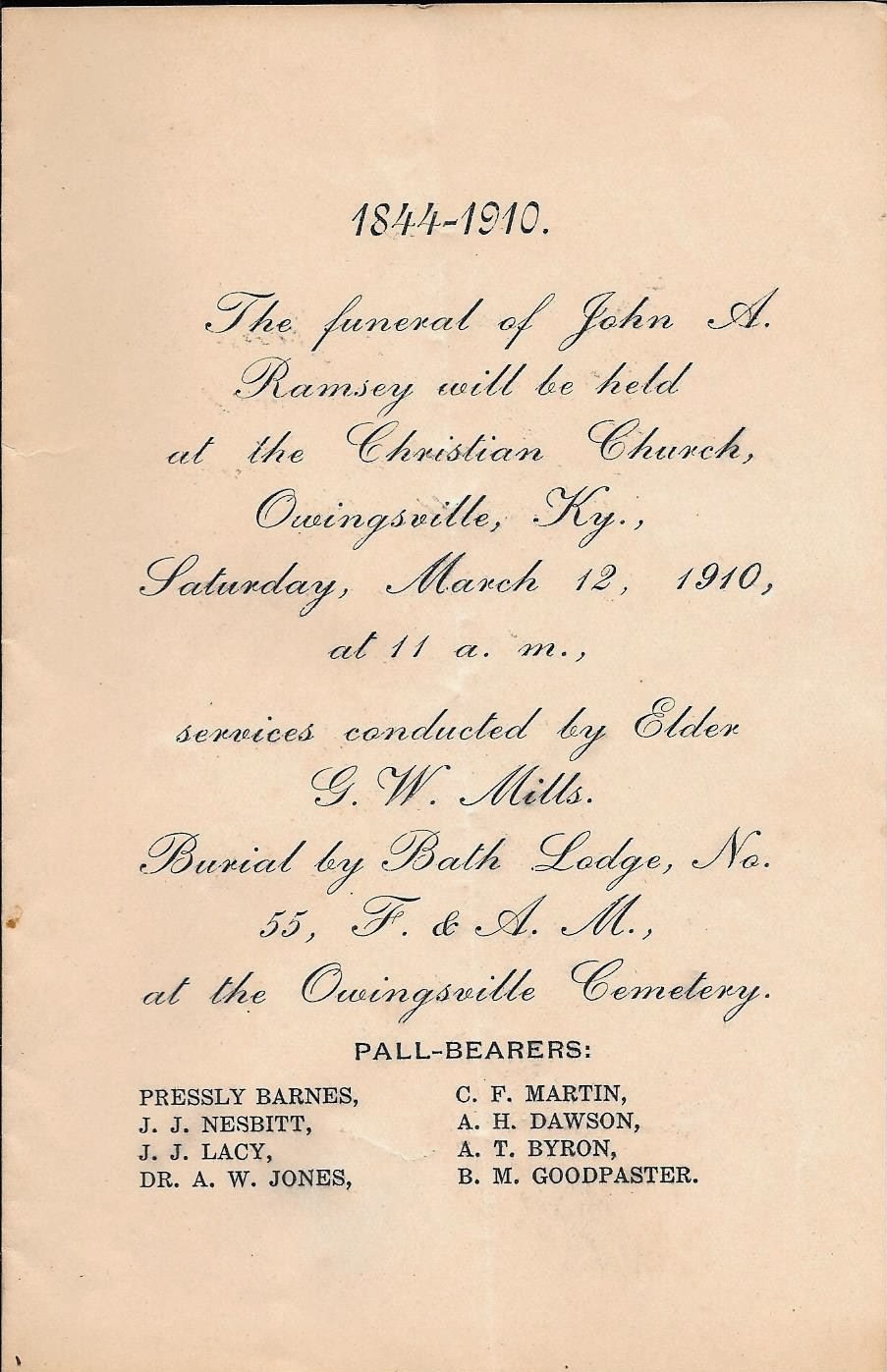
Old Photographs and Funeral Notices

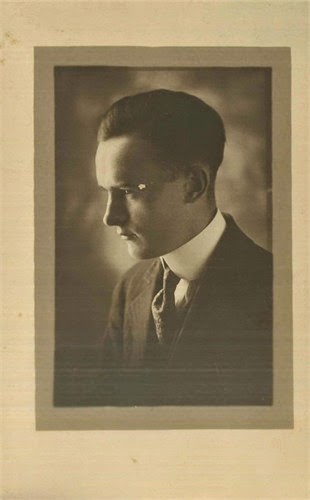
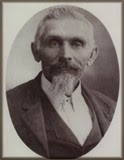
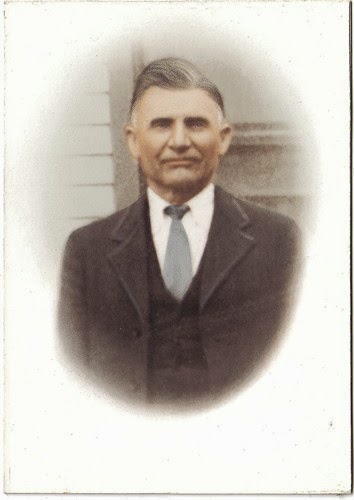
Jefferson Dawson Brother, 1875 – 1975.  Nephew of John William Dawson, below.  He married Elizabeth Prewitt.  We have a letter he wrote while in Germany during WWI that we will share soon.
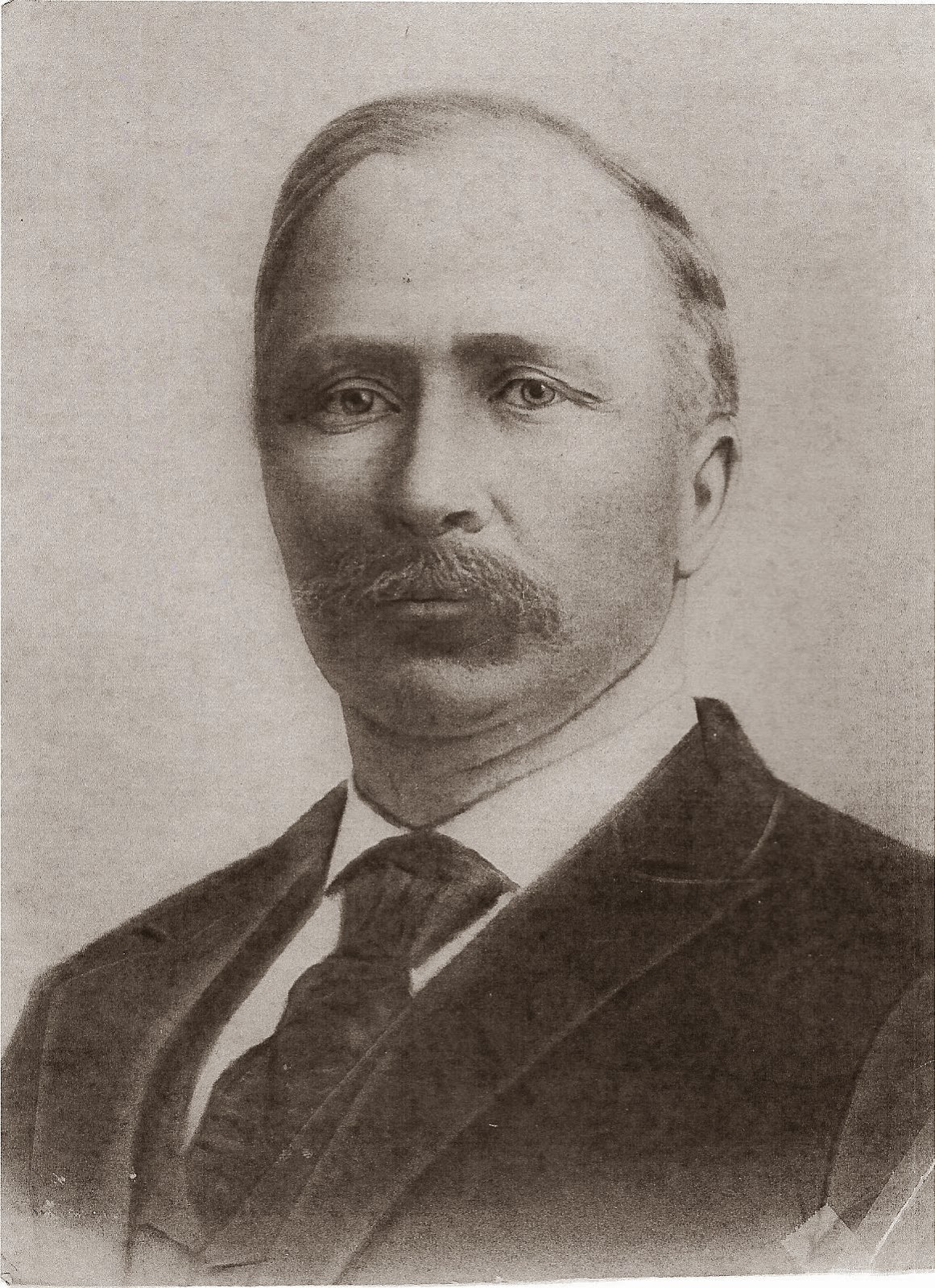
John W. Dawson 1849-1910.  Son of Jefferson Dawson and Eliza Rice.  Father of Emma, Elbert,  Nancy Jane (WBK, Jr.’s mother),  Ashby, Mary, and Stella.  This image was scanned from a reduced copy of the original, which we have.


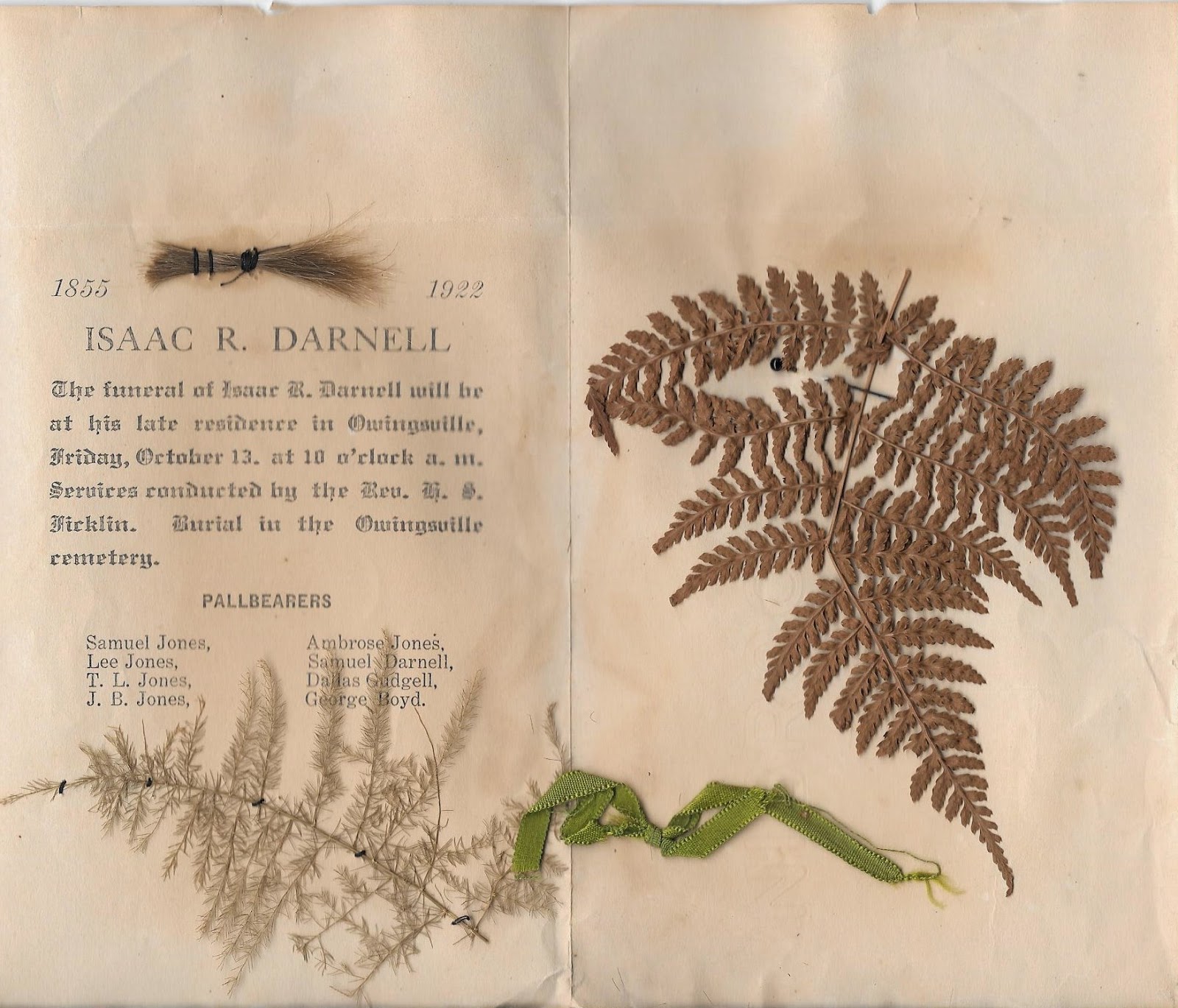
Yes, that is Isaac’s hair!

Rube Fields And His Gift

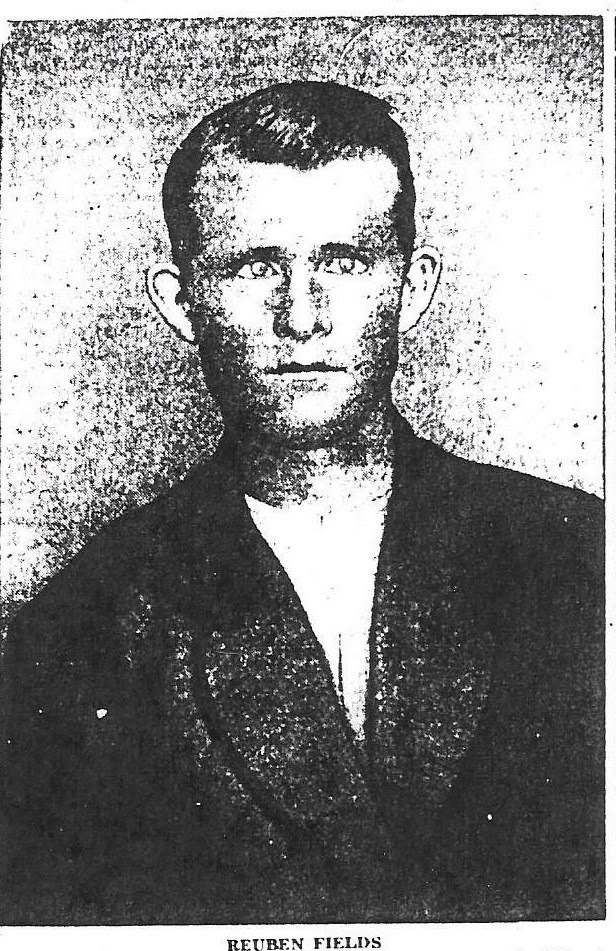
Rube Fields, circa unknown.

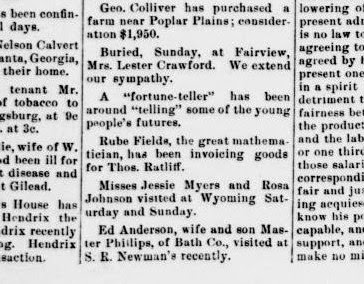
From the January 12, 1899 issue of the Owingsville Outlook.
Note the fourth paragraph about Rube Fields.
 The third paragraph is interesting too!

Many of you have heard of Rube Fields already, but I hope the excerpt below brings a personal element to his story that might be missing otherwise.  My father-in-law spoke of Mr. Fields often, always with a sense of amazement and respect, never with any hint of derision.  There is a lesson in that for all of us. 
Small town living can be hard and it can even be brutal to those who march to a different drummer, but it has long been my opinion that one thing small towns do best is to take care of those among us who may have what we now call “special needs.” I know this is true of our Bath County towns because I have witnessed it hundreds of times in many different ways.  ~Ginger
From the journals:
“I can’t accept money for taking inventory of your store goods because God might take away my gift.” So spoke one of the most unusual persons that ever lived.  This man was born and reared in Bath County and later made occasional trips to Missouri.  Rube Fields has been a legend in Bath County since the time he became an adult.
Rube grew up in the White Oak community.  A multitude of the stories told about this interesting man were true.  There are many skeptics who do not believe Rube could have worked such magic.  If Mr. Fields lived today, he would probably be referred to as a “walking computer.”  Certainly it was uncanny how he could give you the exact time of day without looking at a watch.   Some fellas were not too sure if Rube could tell time by a watch.  It is a fact, though, that he could – if he would – give you the correct time at any time, without looking at one.  Boys, having heard of his power, would slip up on Rube and ask for the time.  Rube would respond, “It’s time you were at home getting in your mother’s firewood.”  Time telling was only a small part of his gift
Mathematical problems and the solving of them seemed to be the greatest gift that this man had.  Rube would not have been able to solve the problem on paper, but would instantaneously give the answer after the problem had been stated.  You might give him a problem such as this:  How many times would a locomotive wheel turn over between Salt Lick and Preston if the circumference of the wheel is 8’4” and the distance by rail between the two points is seven and three miles?  He could respond immediately with the correct answer.
The town council in Owingsville had a large cistern built alongside the old courthouse.* Old cisterns were usually a cylinder which began to taper in toward the top forming a cone, but the cone is chopped off at the top.  The point made here is that not everyone can figure to the gallon what the capacity of such a cistern would be.  The “town fathers” calculated what they believed to be accurate to the gallon and then called in Rube Fields and gave him the dimensions.  Rube unhesitatingly answered and the councilmen informed him that this was one time that he had missed.  Not being satisfied, however, one of the councilmen took the problem to a mathematician (reputedly a college professor of mathematics) and of course Rube had it to the gallon.
Some of the top circuses in the United States tried to no avail to employ Rube but again he stated, “I can’t accept money because God might take my gift away from me.”
Rube loved to go into a cane field and eat and suck on the cane until he had his fill.  He also used soap differently than most.  Rube would rub dry soap on his face until it became red and slick.
Mr. Fields was a large man with a ruddy complexion.  He was well liked but folks often tested him because they wondered about his gift.
Perhaps you wonder about the author’s source of information.  The author’s father knew Rube Fields.  Other fellas also knew this great man with the unbelievable gift.**
It is understood why most people do not believe the exploits of Rube Fields and the author would be one also had his father not known him.  It is thought by some that knew Rube that he died between 1910 and 1912.
For those of you who saw the movie “Rain Man,” Rube was much like the character played by Dustin Hoffman, except that character had some formal education and Rube was illiterate.  The medical term for such gifted persons is “idiot savant.”***
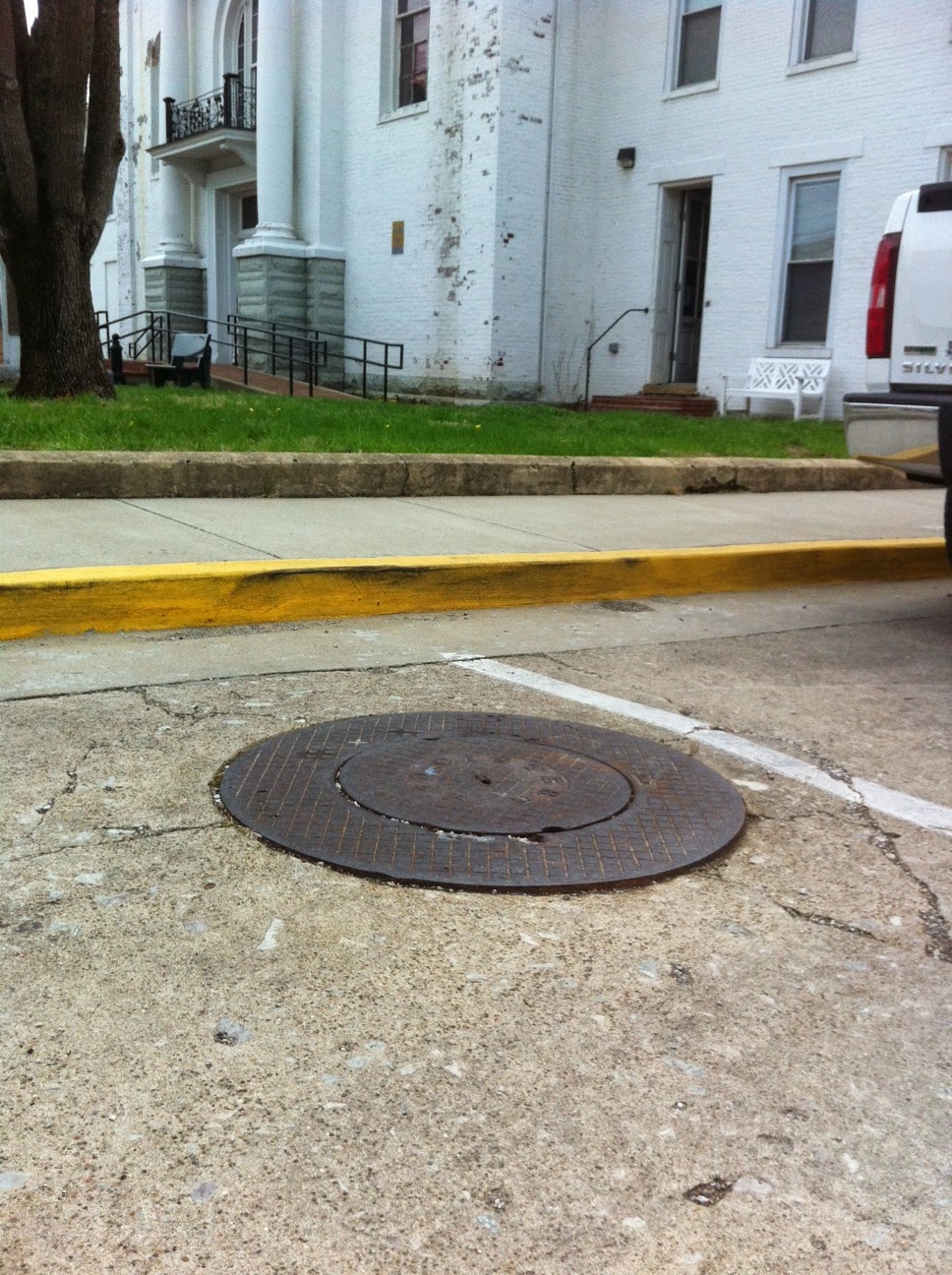
*My father in law notes in the margins of his writing that the cistern is “still to the west of the courthouse near Main Street,” and it is – see the picture below.  You can see the location of several old cisterns on the 1914 maps of Owingsville that we have linked to.   Some of them have since been filled in, and to give you an idea of how big they are, Don says you could fit two cars inside.

**He also notes in the margins that “Mr. Jeff” knew Rube Fields, Mr. Jeff being Jefferson L. Darnell, Don’s grandfather or Mr. Burl’s father-in-law.  I’m sure he heard stories from him as well.

***The term “idiot savant” has fallen out of favor because not all savants have limited intelligence.  “Autistic savant” was used for a while because quite a few (fifty percent) of savants are autistic.  Not all are, of course, so the term “savant syndrome” is now the preferred one.

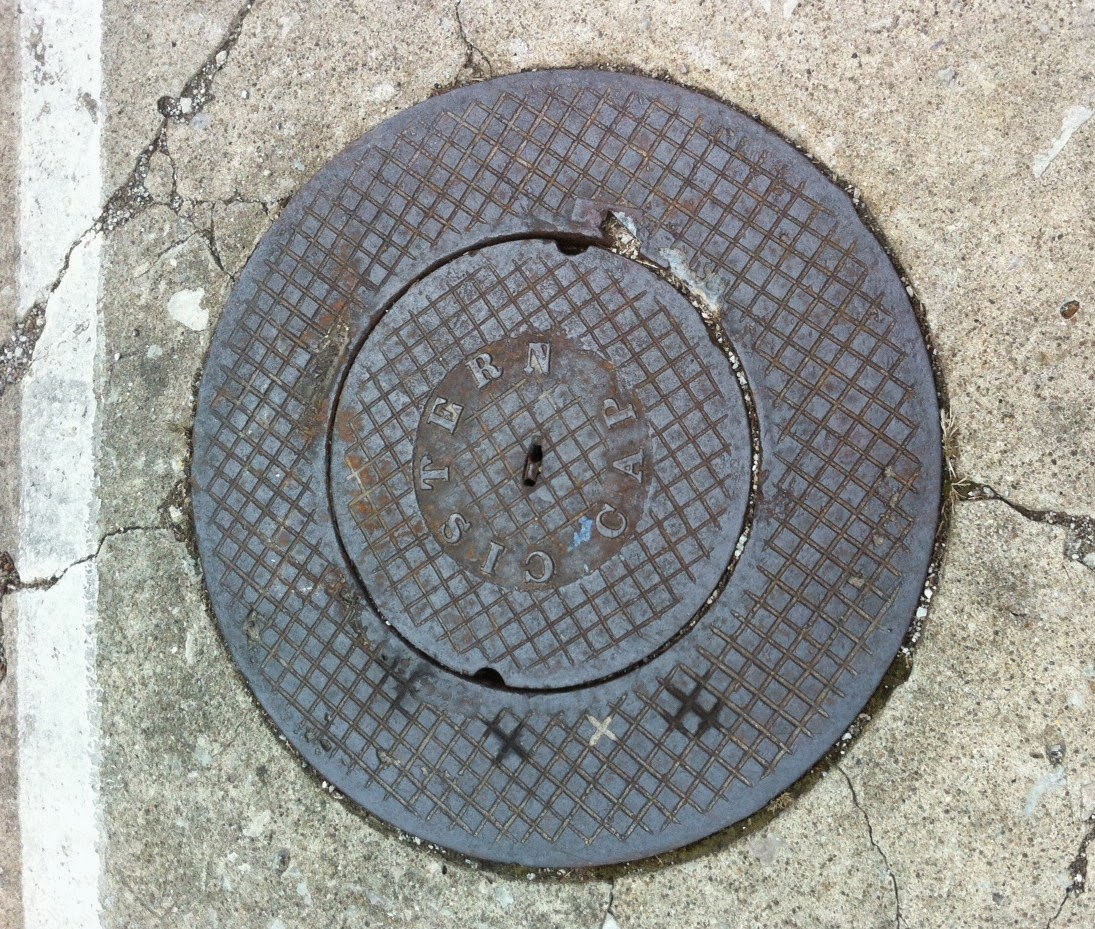
The cistern that was the focus of Rube Fields’ calculations.

The cistern is right beside the court house
– you’ve probably walked by it or over it countless times. 


On Confederate Markers and Ancestors

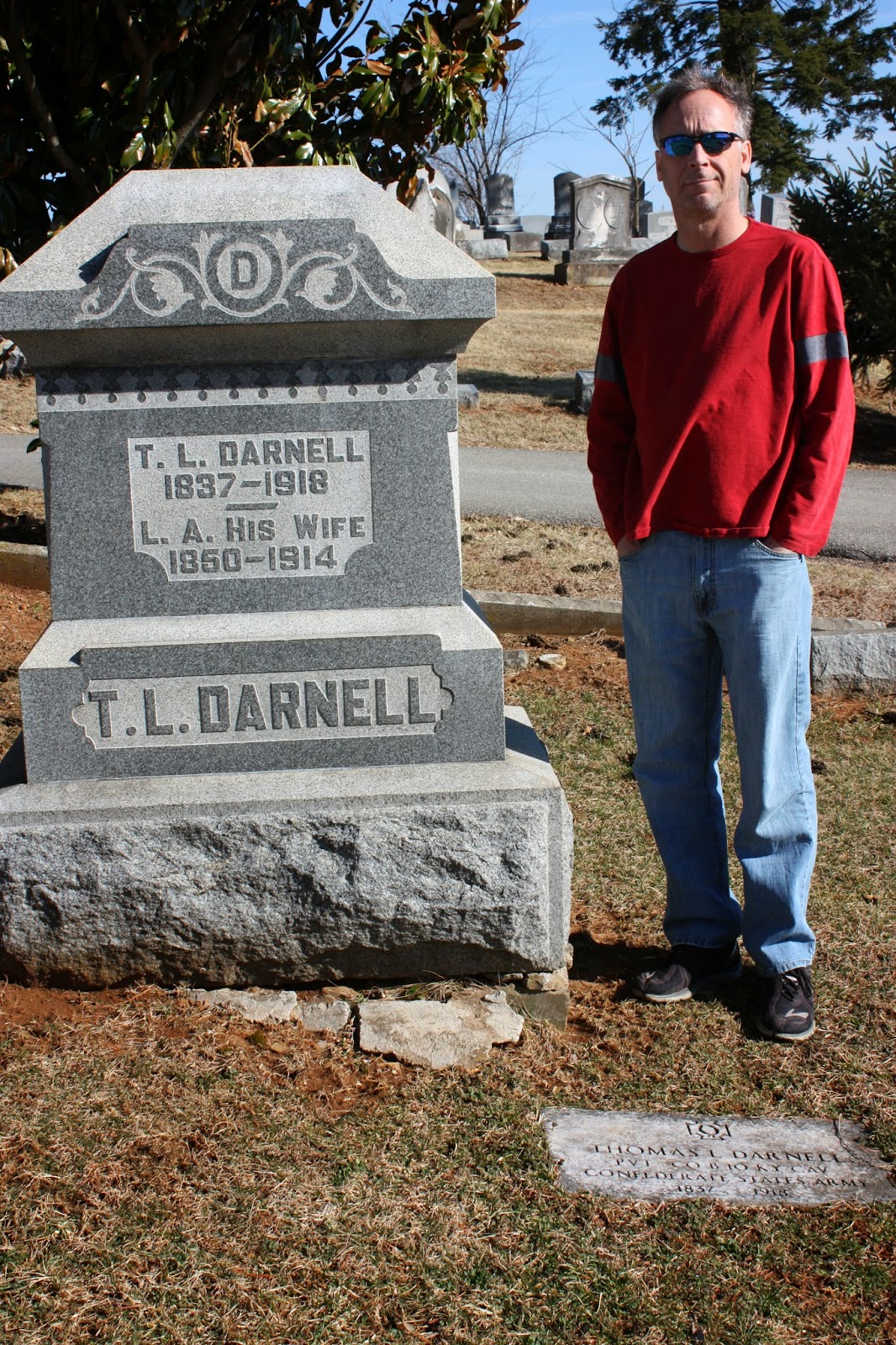
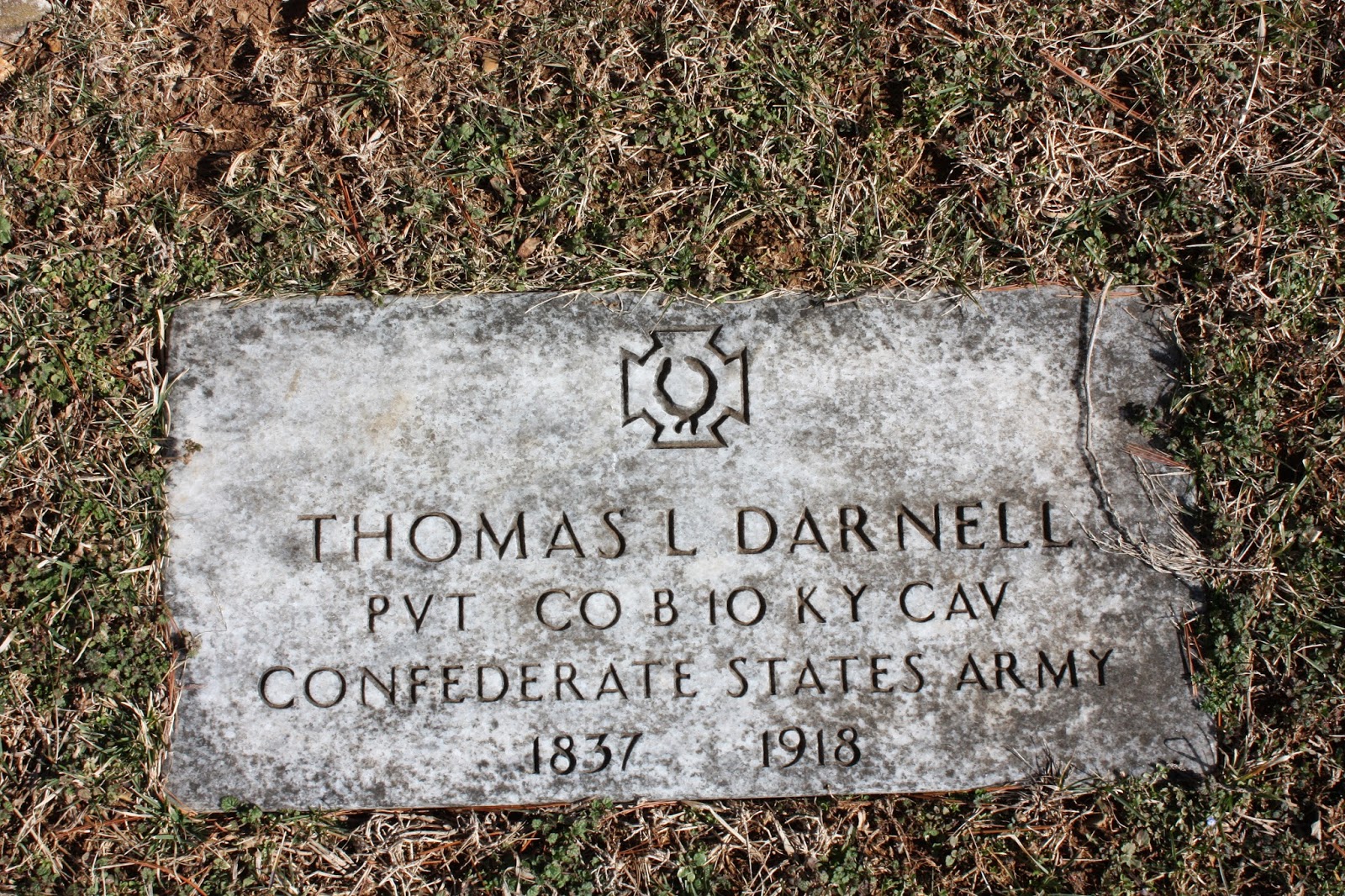
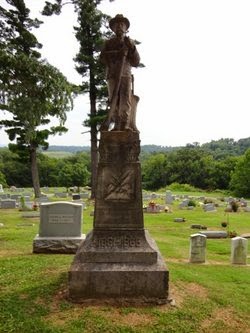
Don Lee Kincaid by his great, great uncle’s burial place in the Owingsville Cemetery.   On the ground in front of Don is a Confederate marker.  T.L. (Thomas) was the brother of Isaac, who was the father of Jefferson Lee Darnell, Don’s grandfather.  The names Jefferson and Lee point to what were at one time the family’s Confederate sympathies. 
 In the South, we learn to make peace with our heritage, and that is not always an easy thing to do.


This week, William Burl Kincaid, III (Bill) makes his blogging debut, sharing his thoughts on the Confederate markers in the Owingsville Cemetery: 


                A few steps east of where our parents are buried in the Owingsville Cemetery stands a statue of a Confederate soldier, six feet tall on a seven-foot base and, of course, facing northward. I sometimes wonder if he ever makes eye contact with the Union soldier facing southward that stands atop a massive war memorial in downtown Indianapolis, where my family and I have lived for the last six years.
                The Owingsville monument has stood sentinel since 1907 and I have looked at it dozens of times. Others have too, I know. It’s on the National Register of Historic Places, so it’s probably garnered a good bit of attention over the years.
                Imagine a bright, warm afternoon in the early part of the twentieth century. A parade forms. School lets out early so girls and boys can join the festivities and, in some cases, participate in them by singing songs and reading essays written for the occasion. The parade stops at the center of town for the unveiling and dedication of the monument.
                As we know from Owingsville, sometimes the monument landed elsewhere, like a cemetery. Or, in the case of Kentucky’s largest Confederate memorial, it stands at what is now one of the primary entrances to the University of Louisville campus.
                I don’t know if a parade or other public events accompanied the dedication of the Confederate soldier in Owingsville, but what I have described occurred in towns and cities across the South when the well funded and extremely well organized Daughters of the Confederacy unveiled their monuments.
                Until a couple of years ago, my impression of the Daughters of the Confederacy was that of a genteel group of tea-sipping, hat-wearing Southern belles who gathered occasionally to enjoy each other’s company and to tell stories of another era.
                The Daughters were interested in telling stories alright, but with a particular angle. (I should say “are interested.” Numerous chapters exist today, including several in northern and western states.) And I’m sure they exuded remarkable grace and charm, but make no mistake about it, they were a force to be reckoned with.
                The Daughters believed that their ancestors’ defeat in the Civil War represented a terrible disgrace. Worse, in their view, was that those same ancestors and most people in the South had been completely discredited and even demeaned in the years subsequent to, as the Daughters would have termed it, the War of Northern Aggression. The Daughters made it their mission to revive and preserve Confederate culture. More so than the men in many cases, the Daughters crafted and promoted the Lost Cause myth through an extensive organization and with various efforts.
                The monuments are probably the best known of those efforts today, but the Daughters also distributed Confederate flags, developed curriculum that promoted Southern values for white children in public schools, provided portraits of Jefferson Davis and Robert E. Lee to be hung in those schools, built hospitals and nursing homes, and offered scholarships to college-bound Confederate descendants.
                My reading about the Daughters has been both fascinating and troubling, especially as the Daughters attempted to preserve racial discrimination and exclusion even as many people in the country were working tirelessly to improve race relations. In her book Dixie’s Daughters, Karen Cox contends that the Daughters’ efforts set back the acceptance and inclusion of African-Americans in this country by several decades, even to the point of undermining the work of the Civil Rights Movement of the 1960s, a full century after the close of the Civil War.
                When I read that I thought of the African-Americans with whom I went to school, grew up and played ball. I also think of the many African-Americans with whom I now work. And even though I find the Owingsville Cemetery one of the dearest and most peaceful places in the world, it now holds a different kind of sadness than it did before
  ~Bill Kincaid


Thomas Darnell’s marker is just one of  many markers placed by the Daughters of the Confederacy in the Owingsville Cemetery.  
We’ll post pictures of the rest of the markers in the future.

 He stands facing north – on eternal lookout for Yankees.

High School and the National Guard (William Owen Karrick Story: Part 3)

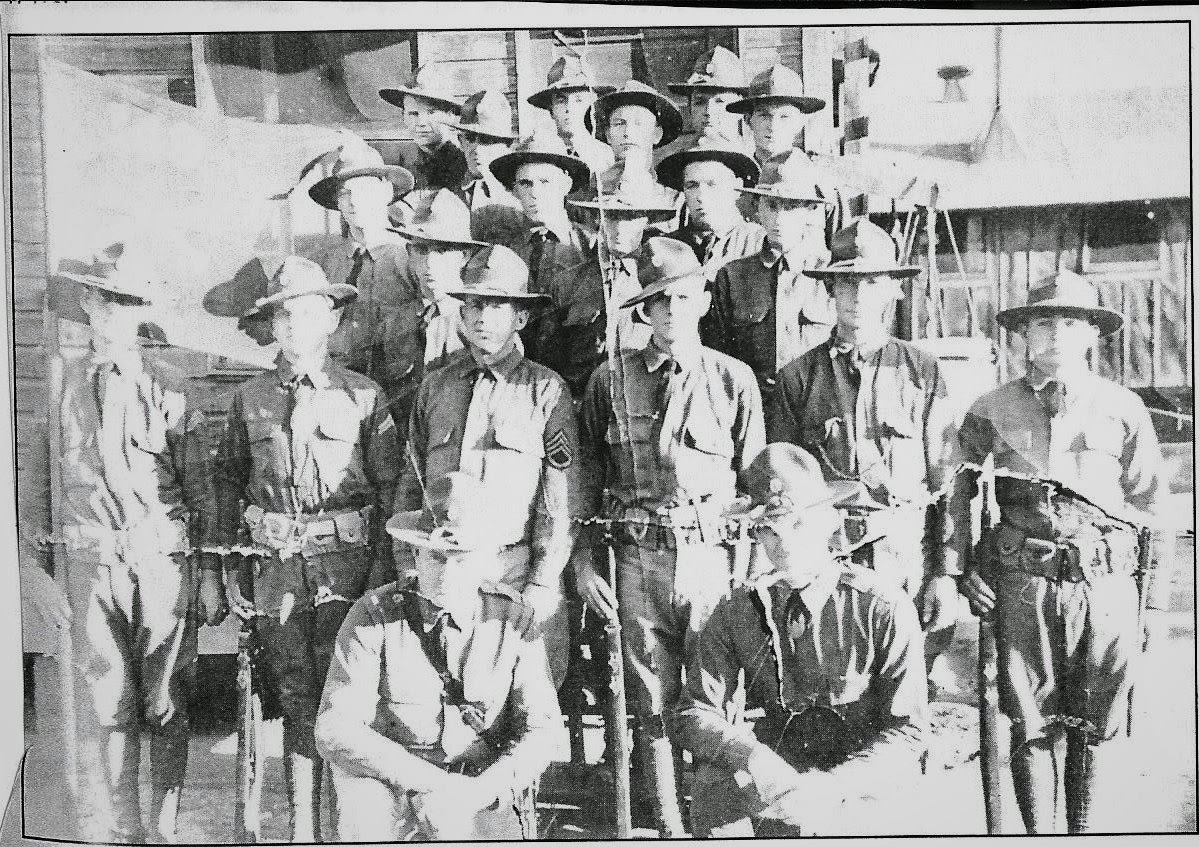
Salt Lick National Guard, 1927.
Those identified are Captain Corbett Gullett, Corbet Copher, William Karrick,
Jim Fawns, Herndon Dickerson, Hugh Karrick, Clifford Wells,
Roger Karrick, Van Green, Billy Frizzell and Robert Clark. 


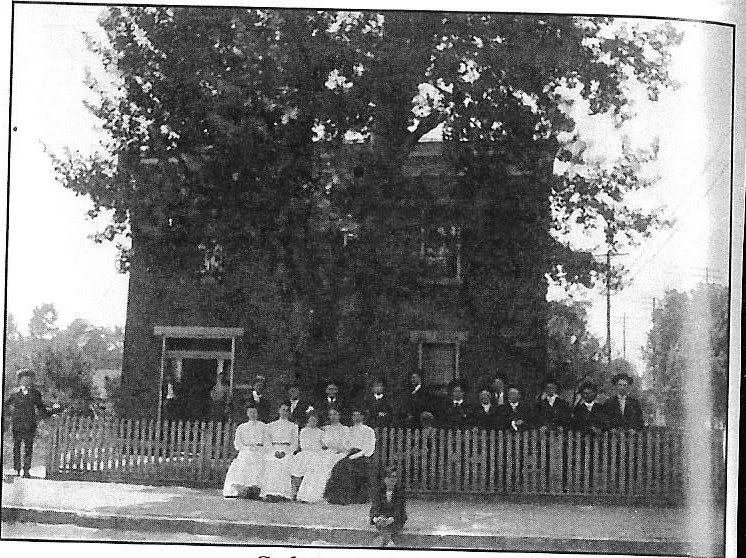
Salt Lick School, date unknown
 
This week, we continue with our series of excerpts from my great-uncle’s memoirs – hope you’re enjoying them!
From The William Owen Karrick Story:
In the first year of high school our class had nine girls and two boys.  They were Phoebe Seese, Olive Fanning, Rosie Freed, Marjorie Shouse (Marjorie married my brother Travis), Ethel Fawns, Opal Reeves, Sudie Maupin, Sudie Davis, Demory Parsons and me.  Our principal was O.J. Harris.  This professor took us to Lexington and Frankfort on a trip.  We visited Sistrunk, a fruit and vegetable distributor, and the federal prison in Frankfort.  This was a good lesson for those who might go wrong and break the laws.
During my second year in high school, a National Guard was established in Salt Lick, Kentucky.  The commander was Captain Corbett Gullett.  I was only fifteen years old at the time but through the permission of my parents, I joined the Guard.  The rifle company was going to Camp Knox for two weeks in the summertime.  Before the summer the guard had a rifle range where I spent several afternoons shooting at targets with 30/30 rifles.  When camp time came along, I received a preventative typhoid fever shot which caused me to have the fever.  I spent several weeks in bed and missed the Camp Knox trip.  In later years, I made the summer trips.  I was in the Guard for almost three years until it disbanded.  I was rated Corporal.
In the second year of high school, our principal was Mr. Wirick.  During this year, my friend Demory Parsons dropped out of school leaving me the only boy in a class of ten. I wanted to quit school too, so I took all my books home and told my father and mother that I had quit.  “Yeah,” Dad said, “You’ve quit.”
“Yes, “says I, “I’ve quit.
“Yes,” says Dad.  “You’ve quit until in the morning then you will return to school if I have to take a switch to you all the way.  Your mother and I have worked hard to see that all of you children finish high school.”
So back to school I went and am I glad that Dad made me return.  However, I was in the Guard at this time, and I skipped an afternoon class several times, going to the rifle range.  I got an F in that class, lost a credit, and had to go an extra semester in school to make up the work.  I didn’t get to graduate with my regular class of 1929.  I graduated in 1930.  The principal was Mr. Welch.
I entered Morehead State Teacher’s College in the fall and went through the first and second semesters and summer school.  I ended up with thirty-eight college hours and a teacher’s certificate good for two years which I used in teaching in a rural one room school at White Sulpher, Kentucky.  I tried very hard to do justice to the children as all eight grades were in one room.  Looking back, I wonder sometimes if that was possible.  My salary for the 1931-32 school year was $76.50 per month, and for 1932-33 it was $66.50 per month because the county was short of money.  School ended in February – a seven month school year.


            And there ends, for the most part, what Uncle Bill wrote regarding his early life in Salt Lick.  I hope you enjoyed his story as much as I did! ~ Ginger

1918 Flu and More (William Owen Karrick Story, Part 2)


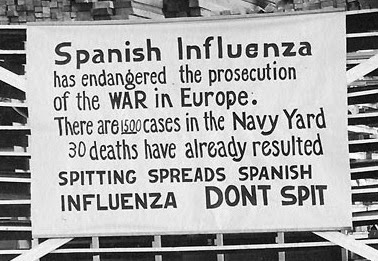
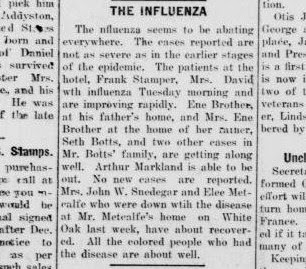
The great flu pandemic hit during the last year of WWI.  More
people died from the flu than from the war.


From the November 21, 1918 edition of the Owingsville Outlook
More from my great uncle’s memoirs this week – in this excerpt, he writes about the Spanish Flu pandemic of 1918.   More than half a million Americans died during the outbreak, and worldwide it is estimated that between twenty and forty million people died.   Children of the time period would skip rope to this little rhyme:  I had a little bird/Its name was Enza/I opened the window/And in-flu-enza.  In my father-in-law’s notes, he refers to the 1918 flu as “La Grippe.”
From the William Owen Karrick Story:
During the cold winter of 1918 our town and many others were afflicted with the flu bug.  All of our family, with the exception of my oldest sister Ethel and me were bedfast.  I remember the cold and the snow.  I would ride our old buggy horse to town and get the mail or maybe something from the drug store.  Didn’t see very many people out and around during these trips.  Several families passed away in Salt Lick that winter.
I had many chores to do, such as feeding the horses and cows, milking, and getting in the firewood.  I had an uncle who would come to my rescue about once each week and a relative, Miss Allie North, would come in occasionally and prepare a big kettle of vegetable soup.  I was seven years old at the time. 
During this year I missed a lot of school.  However, I did get in the second grade the next year.  In the second grade our teacher was Miss Genny Norville.  She was from the old south, and I learned that she had at one time early in her life lived on a plantation.  She never would allow us to sing the song “Marching Through Georgia” during our Monday morning gathering.  She was very strict and would not stop urging us until we had accomplished the goal which she had set for us.
In the third grade, we had the same Miss Genny Norville.  She had us learning our multiplication table from one through twelve.  We had to make a map of the United States and put in the states and capitals.  She kept a switch near her desk and when we got too noisy, she would pick up the switch and come down the seat aisle saying, “I am going to hit east and west to stop the noise.” It worked.
In the fourth grade my teacher was Miss Sewall.  One day a circus parade was going by the school and Miss Sewall had gone out of the room.  All of us in the room went to the window to watch the parade go by.  Miss Sewall returned to the room and when I looked around I was the only one still at the window.  She asked for all who had left their seats to hold up their hands.  I held up my hands.  She came back with a ruler and whipped me in one of my hands.  Was I hurt?  I told her that I wasn’t the only one leaving my seat.  Later she had me stay in at recess and apologized for her action.
Later that year, she promoted me and my best friend Demory Parsons to the fifth grade.  My sister Ethel was the fifth grade teacher.  During this time, I received several switchings from my sister.  Someone would do something and I would get the blame.  When we got home, Ethel would say that she punished me to keep the rest from thinking she wouldn’t because I was her brother. 
The next year in the sixth grade my teacher was Miss Christine Alexander.  Now, she was always nice to me.  I must have behaved well in her class.  She brought a Santa Clause suit and had me be Santa at Christmas.  I was much pleased that she had that much confidence in me.  Later in life she told me that I was one of her prized pupils.  She surely was my most loved teacher.
From the first grade to this time in school our playground activities consisted of town ball, playing tag, seesaw, and the game of marbles when weather permitted.
In the seventh grade my teacher was Miss Snedegar.  Along with other studies she was most interested in us mastering our math.  My brother Hugh was in the eighth grade and he was good in math.  Sometimes our teacher would tell Hugh that his problem solving was wrong and Hugh would go to the blackboard and show her that he was right.
In the eighth grade my teacher was also Miss Snedegar.
By this time we were playing baseball and basketball.  I was only four feet eight inches tall at this time.  My nickname was “Wee Willie.”  In the baseball outfield they could hardly see me.  Would you believe me if I told you that I had grown to five feet eight inches by the time that I finished high school?

From White Sulpher to Salt Lick (William Owen Karrick Story: Part 1)


Hugh Karrick, 1845-1925 (my great, great-grandfather)


 My (Ginger’s) great-uncle William Owen Karrick wrote about growing up in Salt Lick.  For those of you who don’t know, my grandfather was Hugh Karrick of Salt Lick, and his brothers and sisters included Travis (father of Ann and Nan), Edsel (former principal at Salt Lick), Louticia (who taught school for many years in this county) and Virginia (who was the wife of Dr. Milburn Wheeler of Morehead).  There are others, but those are the names with which many of you will be familiar.  Some of my papaw’s siblings lived their lives away from Bath County.  My Uncle Bill did, but, as you can tell upon reading his words, Salt Lick always held a special place in his heart. 

From The William Owen Karrick Story:
I was born March 7, 1911 at White Sulpher, Bath Co., Kentucky.  My father was James Thomas Karrick and my mother was Mary Warner Karrick.  I was the seventh of twelve children in the Karrick family.  Midwife Kate B. Nickell of Ewing brought me into this world.
I remember several instances in life when I was three years old – such as sitting on my father’s knee while he played the violin, bouncing me up and down.  Several of my uncles were present at Christmas 1914.  They had brought whiskey from Mt. Sterling, Kentucky, but I can’t remember anyone getting drunk other than my oldest brother, Paul.  On one occasion Paul decided to play drunk-man.  He poured and drank a cup of whiskey and ended up very sick, with a promise never to play drunk-man again.
I remember riding on a roof shingle over an embankment in our side yard when the snow was on.
I remember wanting to go with my older brothers to their rabbit boxes down in our orchard.  Of course they didn’t let me go.
I remember well the day that we moved from White Sulpher to Salt Lick.  We were riding in a buggy – a one horse carriage.  I was four years old at the time.  I was seated on the floor board, Mother (holding my sister Gertrude) and Dad were in the buggy seat, and my brother Hugh was standing up behind the buggy seat.  I thought this trip of approximately three miles was a very long journey.  We finally arrived at our new home in the afternoon.  Three of my older brothers had preceded us with two wagons and our furniture – the last two loads.
My grandfather Hugh Karrick and grandmother Leticia Karrick had moved to Salt Lick earlier.  They lived next door to our house.  As soon as I could, I made a mad dash over to Grandmother’s house.    I had visited with my parents when my grandparents lived on a farm at Mudlick before moving to Salt Lick.  I spent many happy days at my grandmother’s house.  She always had plenty of milk and molasses cookies.  The cookies were in a big jar which I could reach.
At the age of six I started to school at Salt Lick.  I had a teacher named Maude Wright.  I remember the first day very well.  I wanted to go to the same room with my brother Hugh but he insisted and I went to the Junior Order school building across the road from the main school building.  I can’t remember too much of the first year of school except my dad helping me learn to read.  He was always ready to help any of us with our studies.  Our mother was the main spelling teacher. 
James Thomas Karrick, 1870-1944 (my great-grandfather).
 

More Old Receipts

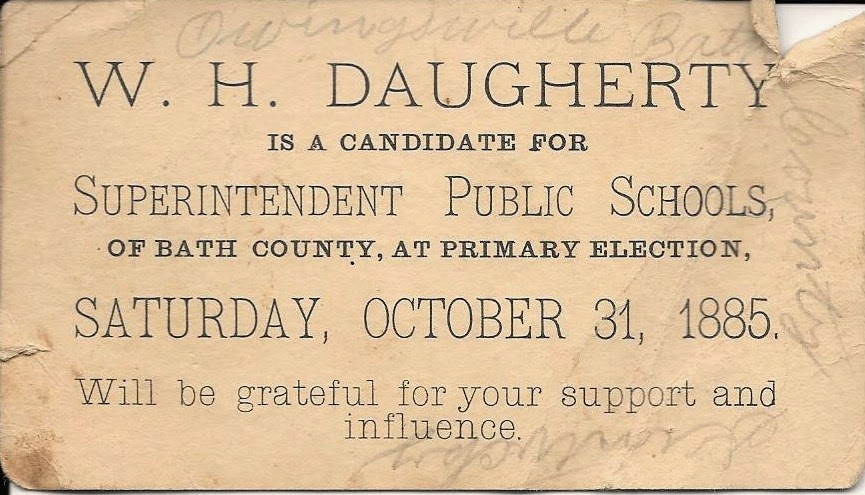
Not a receipt but a campaign card for school superintendent, 1885.

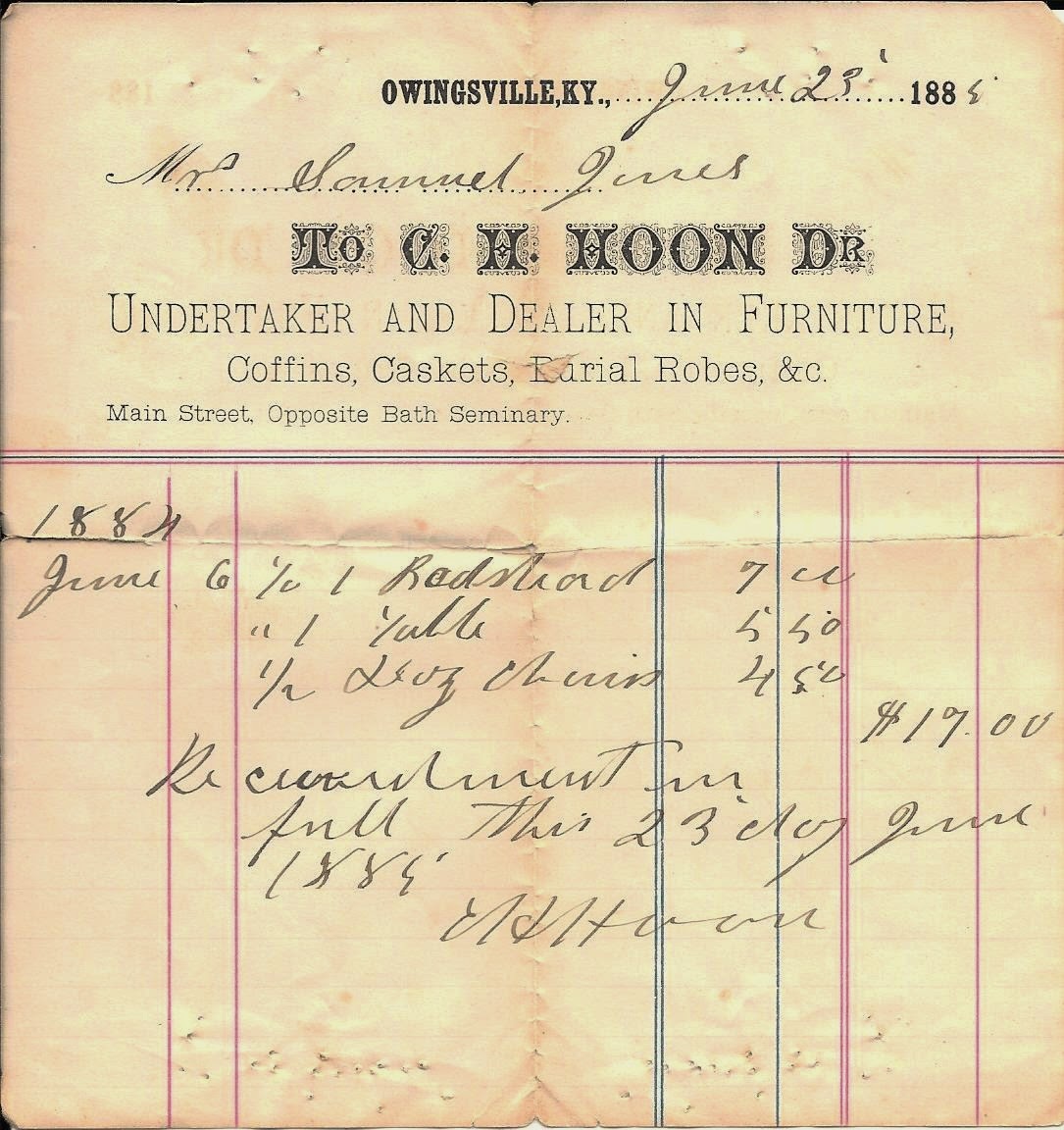
Receipt from the undertaker (last number in year is hard to read, but I think it says 1884).  

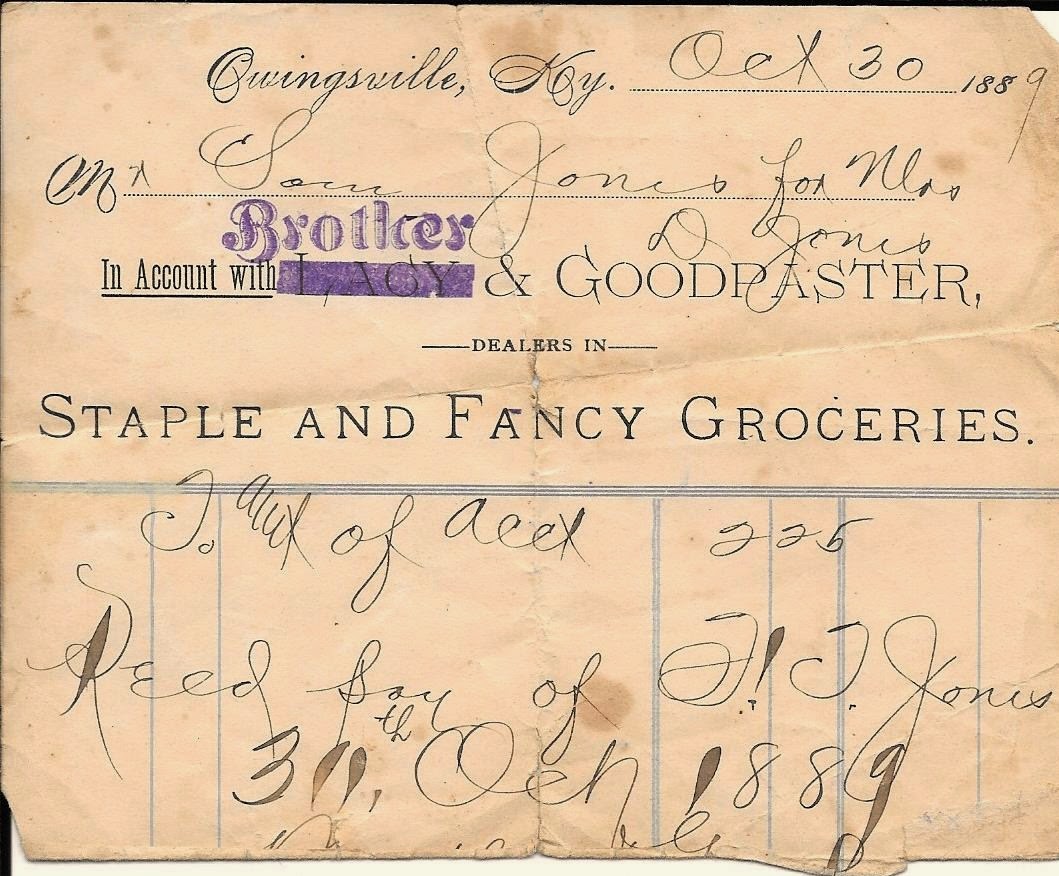
Brother & Goodpaster receipt, 1889.
The name “Lacy” has been blotted over  and  “Brother” stamped above it.

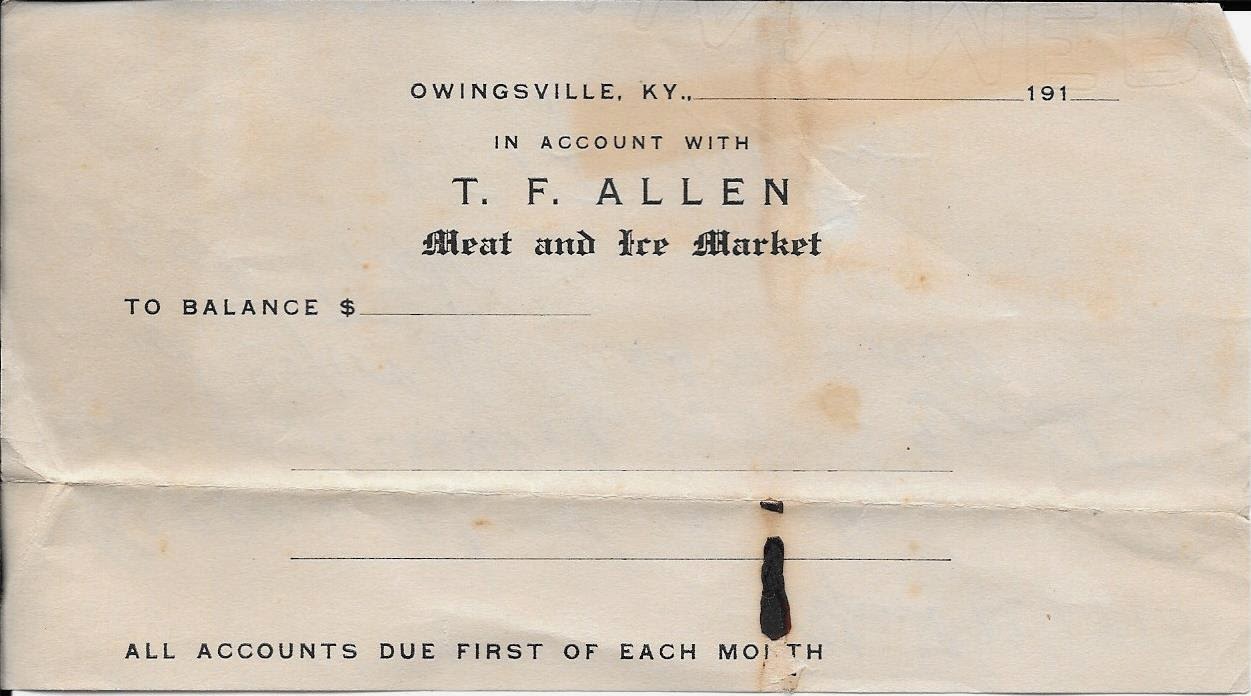
Receipt from T.F. Allen Meat and Ice Market,  1915
 (the actual transaction is recorded on the back)