A Hometown Baseball Legend

f6578-owingsvillegiants
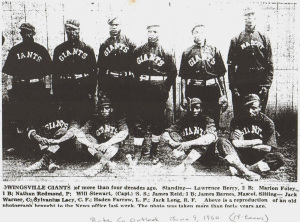
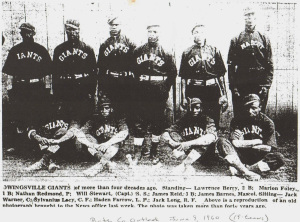
The Owingsville Giants.  Nathan Redmond is third from the left in the back row. Photo courtesy of The Bath County Outlook.

My father-in-law, William Burl Kincaid, Jr., was a huge baseball fan. Well . . . he was more like a fanatic.  Some of my fondest memories are of going with him to watch his beloved St. Louis Cardinals play their exhibition games in Louisville and watching them play their championship games on TV in his living room. This was back in the 1980’s when they boasted such players as Willie McGee and the outstanding Ozzie Smith. There was one hometown player from the 1920’s that he thought ranked right up with these greats. ~ Ginger

From his journals:

Ty Cobb, Walter Johnson, Jackie Robinson, Babe Ruth, Ted Williams, Stan Musial, and Willie Mays. If you love baseball, you have heard of the exploits of these baseball players, but have you heard the name Nathan Redmond?  This man was legend around Owingsville. To begin with, he was endowed with a fine physique.  He stood about six-two and was well proportioned.

Nathan, in his younger days, was noted as a pitcher with a blazing, screaming fast ball. Today, baseball fans would say that he threw “heat.”   Many batters – good hitters – were caught with their bats on their shoulders.  Of some that did swing, it was too late because of the velocity of his pitch.

Nathan, like many pitchers today, unfortunately developed arm trouble and that blaze he had thrown was slowed down.  Being a great hitter (especially of the long ball), Nathan began to play first base and was a standout there.  

The author saw him play many times and on occasions remembers the left-handed batter hitting one that rolled across U.S. 60 from Kimbrough Park.*

Had Nathan Redmond lived now or in recent years, those who remember him feel that he would have starred as a big leaguer.  In his day, Nathan could not have been a National League or American League player because of his color.

Some of you remember the men who played with Nathan.  To name a few – Jim Reid, Jerry Lacy, Bob Foley, Dusty Stewart, Diner Gray, and Lawrence Berry. **

* Kimbrough Park was located in the vicinity where the Southern States lot is and across from Steve Butcher’s car lot on U.S. 60 East.

**I’m not completely sure the names Dusty and Diner are correct as those words are difficult to make out in the text. If they are wrong, please make a comment or drop me a note.
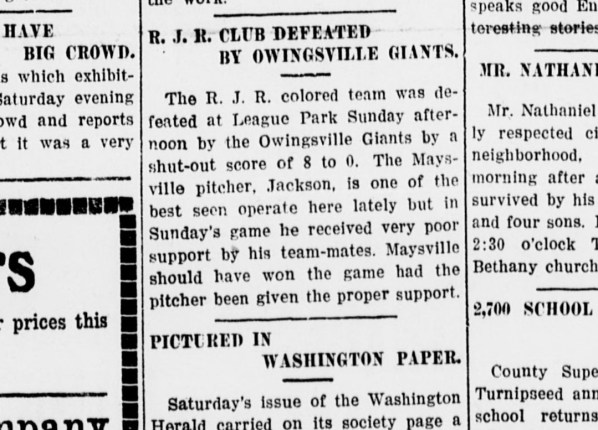
sn85038022 1921-07-18 1 1 image 681x648 from 973x3401 to 2807x5148
A news clipping from July 18, 1921 edition of  The Public Ledger (Maysville, Ky). Image courtesy of the University of Kentucky via The Library of Congress.

Doctor Byron’s House Gets Built and Other Tidbits from Miss Jane.

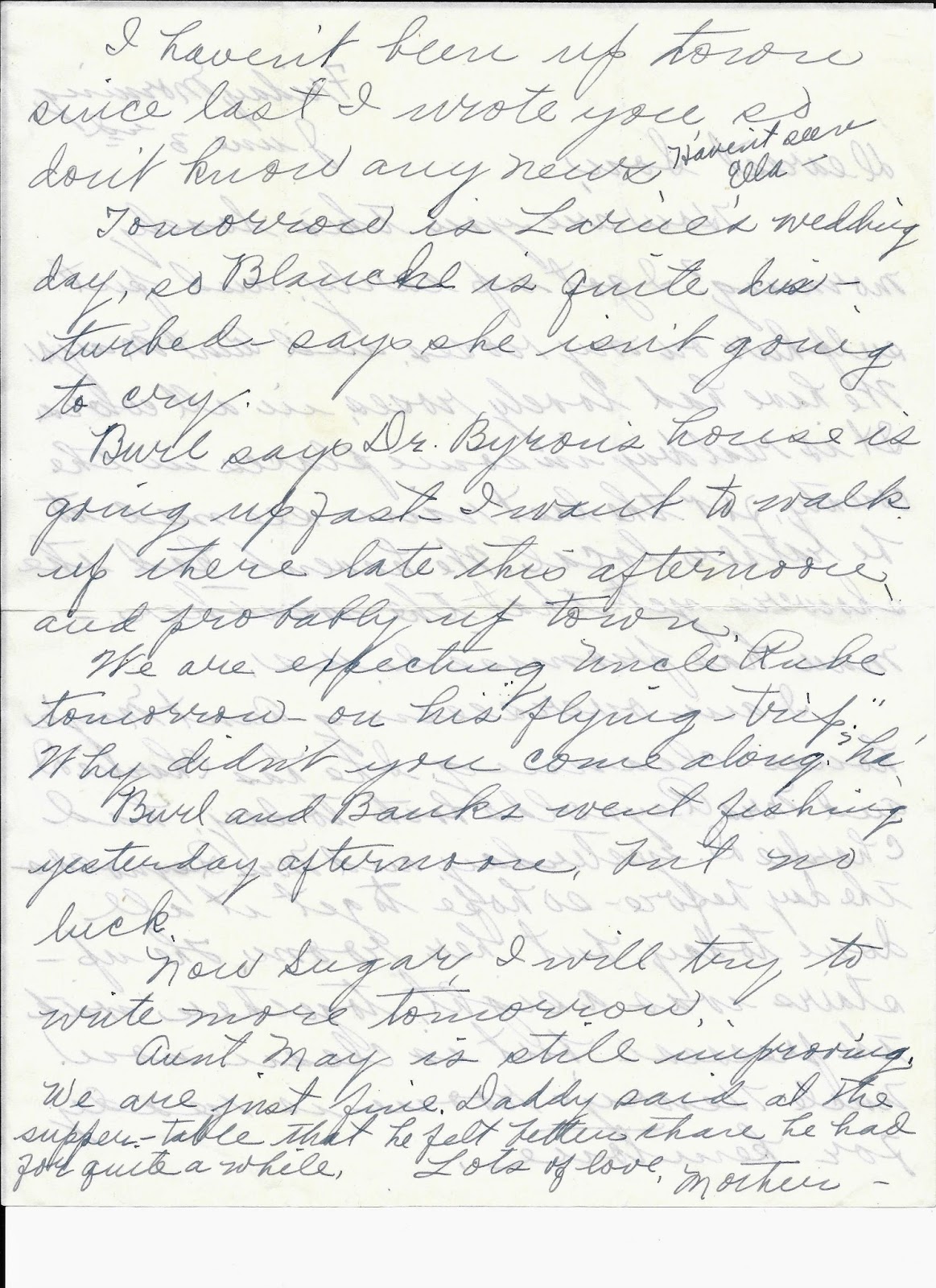
From Miss Jane on Friday morning, June 3rd, 1949:

Dearest Son,

     How are you this lovely morning? I got up early  and put sulphur on my roses and Aunt May’s. We have had lovely roses, in all colors. It is really dry in some places in the county, for the last rain seemed to be rather local. We haven’t had the showers yet that the weatherman has promised us.

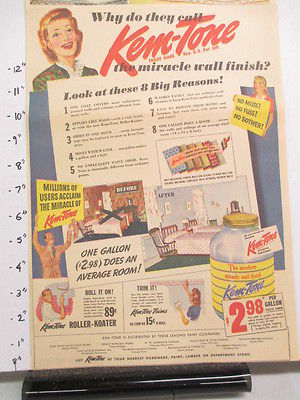
     I am overseeing Aunt May’s house-cleaning.  She has Charlie D. and Mrs. Reynolds both today. Had Charlie D. yesterday and Mrs. Reynolds the day before – so hope to get it all done today but her room. The upstairs was a sight, together with the presses – but is clean now. Uncle Henry’s room is ready for kemtone [a paint].
     I haven’t been up town since I last wrote you, so don’t know any news.  Haven’t seen Ella.
     Tomorrow is Larue’s wedding day, so Blanche* is quite disturbed – says she isn’t going to cry.
     Burl [Sr.] says Dr. Bryon’s house is going up fast – I want to walk up there late this afternoon and probably up town.
     We are expecting Uncle Rube tomorrow – on his “flying trip.” Why didn’t you come along? ha!
      Burl and Banks [Thompson] went fishing yesterday afternoon, but no luck.
     Now Sugar, I will try to write more tomorrow.
     Aunt May is still improving.  We are just fine.  Daddy said at the supper-table that he felt better than he had for quite a while.

Lots of love, Mother

*We’re not sure who Larue is or why Blanche was disturbed.  It took us forever to figure out that Blanche was a nurse hired by the family to live in the house and care for Aunt May.  We found that from a census record.

An early ad for Kem-Tone paint. 

The Owingsville Panthers

From the journals about a basketball team that he played on. He and his teammates would have been between 18 and 21.

Prior to the 1935-36 basketball season, a group of young men organized a semi pro team. After much discussion regarding organization, uniforms, transportation, finances, and team name, it was apparent from our first talks that we would like a name not being used much in our area so we chose the name “Panthers.”  Having attractive, colorful uniforms required much input from the squad members. Finally, we selected crimson and gray (Ohio State University colors) which made a very striking outfit.  Our warm-up jackets were crimson with gray sleeves and they had a Panther head to the left on the chest.  Fortunately, we knew Roy Kissick who was the proud owner of a huge Cadillac(with jump seats) and would transport our team. On occasions he would crowd 13 in that fine car.

The Panthers scheduled several independent or semi-pro teams in this area, such as Paris, Camargo, Morehead CCC, Carlisle, Little Rock and others.  We won more than half of the games we played.

The Panther Squad

Coach Morgan Steele

Players:
John H. Elliott
Roger Byron
Burl Kincaid Jr.
Harold Reynolds
Charles Hazelrigg
Charlie McKee
Charles Anderson
“Dinks” Jones


What was Owingsville and the world like in 1916?

There was no I-64. It was built in the 1960’s. The main road was the Midland Trail which was gravel.
The automobile of the day was the Ford Model T and they were all black.
To go somewhere of any distance, you went to Preston or Olympia and caught the train.
US 60 as we know it did not exist until 1926, when they built it out of concrete.
There were no microwave ovens, stoves of the day were probably wood burners.
There was no natural gas for gas stoves and the main heat was coal burning stoves.
No clothes dryers existed – you hung them on the clothes line!
Half of all homes in the US didn’t have electricity. Most still used oil lamps.
High Street was a gravel road and all the houses on the street had fences because . . .
turkeys, cattle, pigs were all driven or walked down the main streets.
Morehead State University at that time was called Morehead Normal School.
There were no…..
computers,
cd players,
ipods,
cellphones,
air conditioners
televisions,
cable for tv’s,
Internet,
mini calculators
Subway, McDonald’s, Dairy Queen, or Pizza Places,
Only 8% of all homes in the United States had a telephone.
A loaf of bread cost 7 cents and sugar was 4 cents per pound.
Most families had chickens, pigs and a garden….in town!
The population was 942 – in 2010 the population was 1592
Owingsville was 105 years old – this year it is 205 years old
Owingsville was exactly 1 square mile – it is now approximately 2 ½ square miles.
There were no water faucets in the house,  Water came from wells – the city water works were built in 1927.
There were no indoor toilets.  Every building had a privy or outhouse in the back yard.
There was no city sewer system – it was built in the mid 1950’s.
There were no street lights.
No weather radar or army radar existed.
No radio, if you wanted the news, you read the newspaper.
For fires, huge cisterns were built, many of which still exist.
World War 1 was being fought in Europe.


Daddy talked or wrote about all of these things at one time or another. He loved history and the memories of his town. He was born on February 23, 1916.  This coming Tuesday, February 23, 2016 he would have been 100 years old.

Don

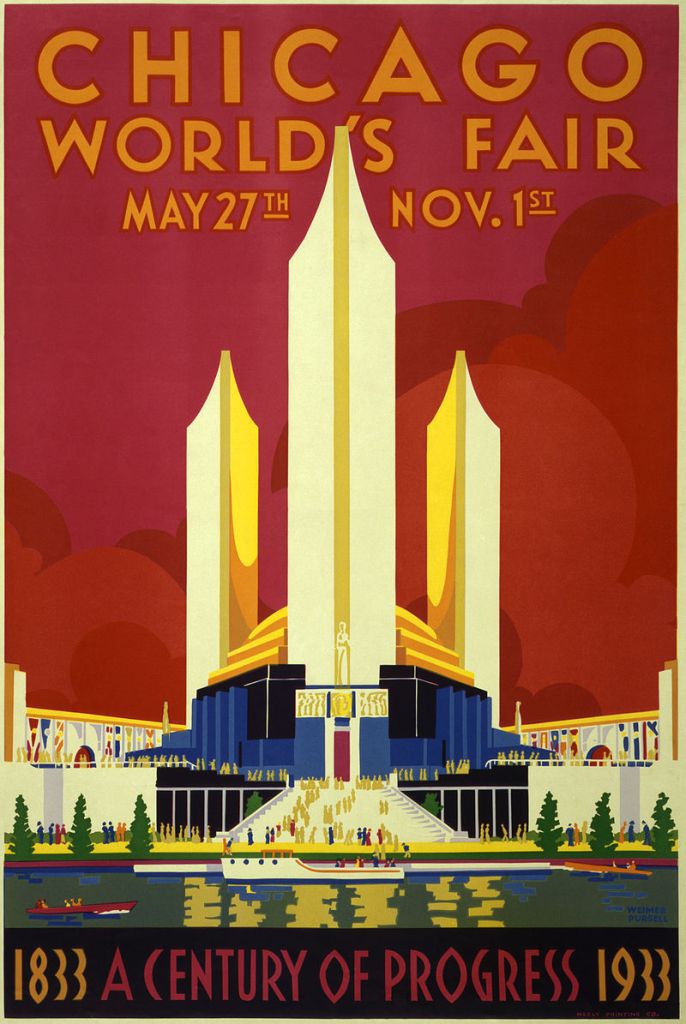
TV in 1934? A Trip to the Chicago World’s Fair.

By Weimer Pursell, silkscreen print by Neely Printing Co., Chicago – This image is available from the United States Library of Congress

From Daddy’s notes on the 1933-1934 Chicago World’s Fair:

What is Television? Who are you trying to kid? Projecting a picture and sound through the atmosphere? No, we believe this to be some kind of joke!  Well, let’s go in and see about this thing called television.

Five young Owingsville men, after hearing all the glowing remarks about the Chicago World’s Fair(also known as “A Century of Progress”), decided to journey to this big city. The young men were, Richart Brother, Bronson Snedegar, Burl Kincaid Jr., John H. Elliott, and Theodore Crouch. Theodore was older than the others and owned an automobile, so the other four supplied the gas and oil. Off and away they went to a week of fun and education. 

    
This was in 1934 which was in the heart of the so called “Great Depression.”  For those of you who do not remember that era, there was little money in the United States. Many families found themselves with every member unemployed. If you did not live during those years, there is no way that you can imagine what some fellas lived through.  

Upon entering the building which was built for the display of this new media called “television,” we were surprised at the shape of the auditorium or theatre (we did not know what to call it). The building was narrowly rectangular with a telecasting booth in one end and a large TV screen in the other. The large center section had seating much like movie theatres. Since it has been some 60 years since being privileged to witness a great electronic device being publicly born, the writer does not have much idea as to the number of seats. 


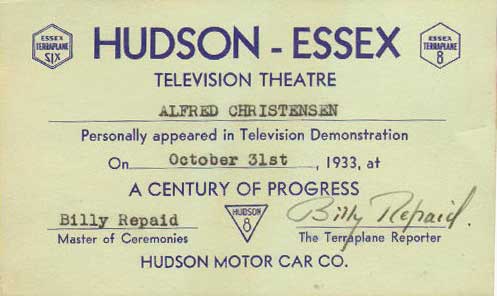
The young men were seated together and were anxious for the program to start. The announcer made some glowing remarks about the fair in general and TV in particular. A program was presented (do not remember much about it) but the presenters were concerned that the audience might think the whole thing could be a fake. To dispel any thought of the presentation on the screen being a fake, a person surveyed the audience and asked certain persons to go to the telecast booth. It seemed that he chose one person from each group. The writer was chosen from our group and got to be on television!

Daddy spoke of this trip often. He and others were only eighteen years old. He brought back the official book from the fair and we still have it.

His favorite area was the Little Town. It was an exhibit of everything small, with an entire home and its furnishings built on a small scale, but still big enough to enter and walk around.  ~ Don Kincaid

A participation card from the television exhibit at the Chicago World’s Fair. Image courtesy of https://www.earlytelevision.org/chicago_1933_worlds_fair.html

For more information about the Chicago World’s Fair of 1933-1934, you can visit the following links:

https://en.wikipedia.org/wiki/Century_of_Progress

https://www.earlytelevision.org/chicago_1933_worlds_fair.html

Minihan Saddles

From Daddy’s notes:

Bath County at one time produced some of the finest saddles obtainable.  The saddles were custom made to fit the individual. There are today some of those saddles still around.  Doris Darnell Kincaid owns one of those prized saddles as do some other Bath Countians.


Eugene Minihan founded and operated the saddlery business in O’ville.  He surround himself with several skilled employees and produced the renowned Minihan saddles. His shop was located where Dr. D.C. Cameron now has his office on the west side of Jefferson St. 


Mr. Minihan only made saddles for the individual, in other words, tailor made. The finest leather was used and the workmanship was excellent.  Great pride was taken in the comfort and fit built into the saddles.  

The author has one of the small anvils used by Mr. Minihan in the making of his fine saddles.

After 50 years of the Minihan saddle hanging in a hot garage, my mom sold the saddle to a collector in Cynthiana.  He cleaned and repaired the saddle and it is on display in his workshop. 


From the internet about Minihan:

“Eugene Minihan is credited with originating the “Kentucky Springseat” saddle. Mr. Minihan made these saddles in his shop in Owingsville, KY from the late 1880s to the time of his death in 1926. Many knowledgeable horsemen consider them the finest riding saddle ever. Minihan took a standard Somerset Broad Cantle saddle tree and removed the center of the tree bars, then spliced in pieces of stiff leather to make a sort of “hinge”. This was the first, and most successful, flexible tree design. It is very labor intensive to construct, and new saddle trees of this type are not commercially available. Original Minihans are highly prized, and several skilled saddle makers rebuild them on the original trees.”

Don


Letter to the Herald-Leader about Frank Jones


Mike Fields, Staff Writer
Lexington Herald-Leader Co.
100 Midland Avenue
Lexington, KY 40508

Sir,

Read your column Friday 19th and noted your piece about Jeremy Simpson and Mark Higgs.

In 1969, Bath County had a great running back-Frank Jones.  Frank was the leading scorer in Kentucky high school football that year.  Jones scored 38 TDs and 22PATs for a total of 250 points.

Jones rushed for a total of 3,361 yards in 327 carries in 1969.  Frank’s average per carry was 10.24 yards.

The above statistics ware taken from the Nov. 13, 1969 Louisville Courier-Journal.

Also, Frank Jones is the all-time rushing leader for Morehead State University.

Am enclosing a copy of the Courier-Journal article from which the above statistics were taken.

Yours for good sports,

W. Burl Kincaid, Jr.
Owingsville, Ky

Jones still holds the record he set in 1969 for rushing a total of 3,361 yards.  
Official records of this can be found at KHSAA internet link below.  Don

http://khsaa.org/records/football/individualrecords.pdf

DARNELL FAMILY COLORIZED PHOTOS

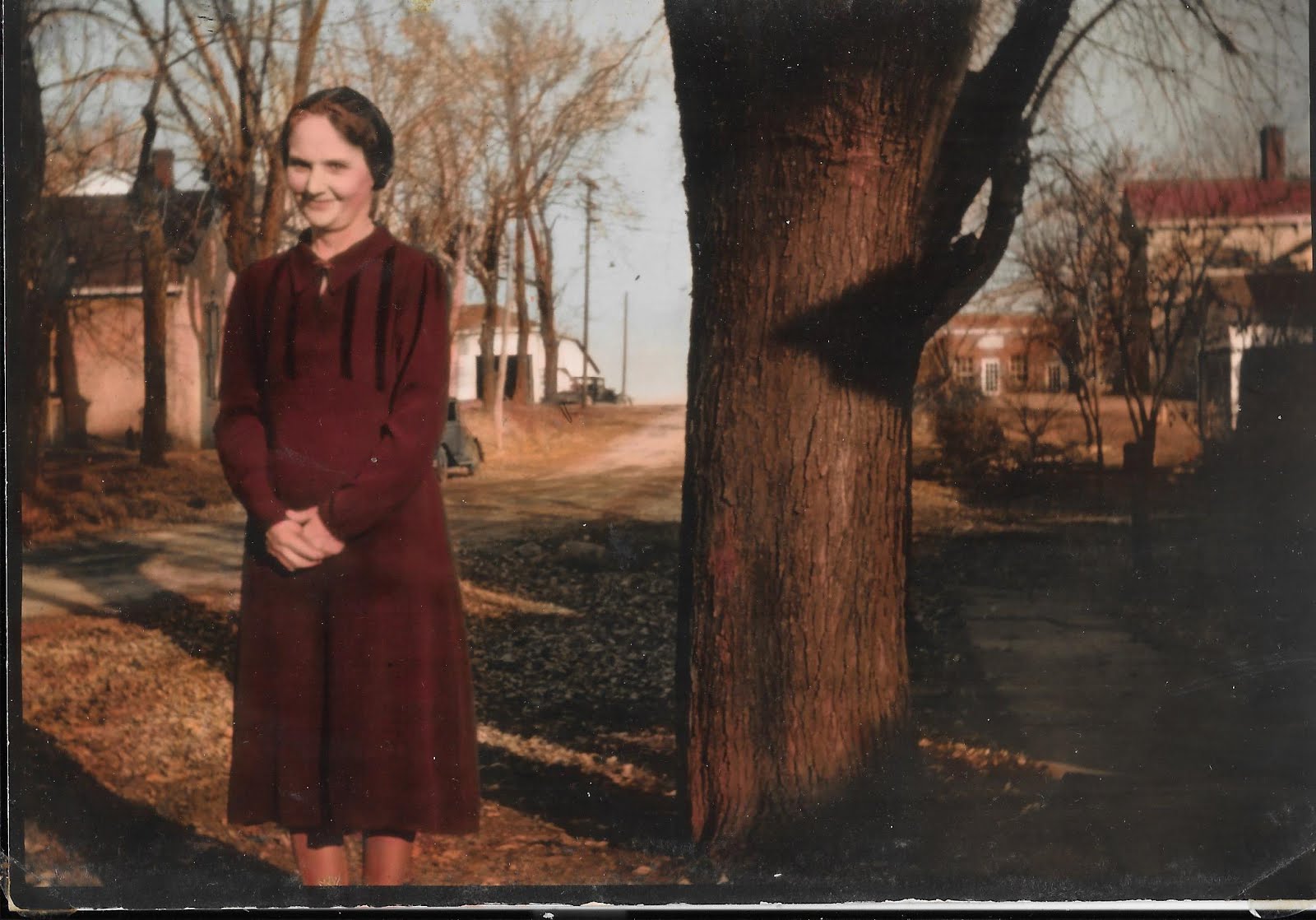
This photo of my grandmother Sallie Darnell was taken in about 1940 in front of their home on Coyle St. in Owingsville.  Mr. Jeff must have been at work at the bank.  In the background you can see three buildings still in use on Slate Ave. in Owingsville.

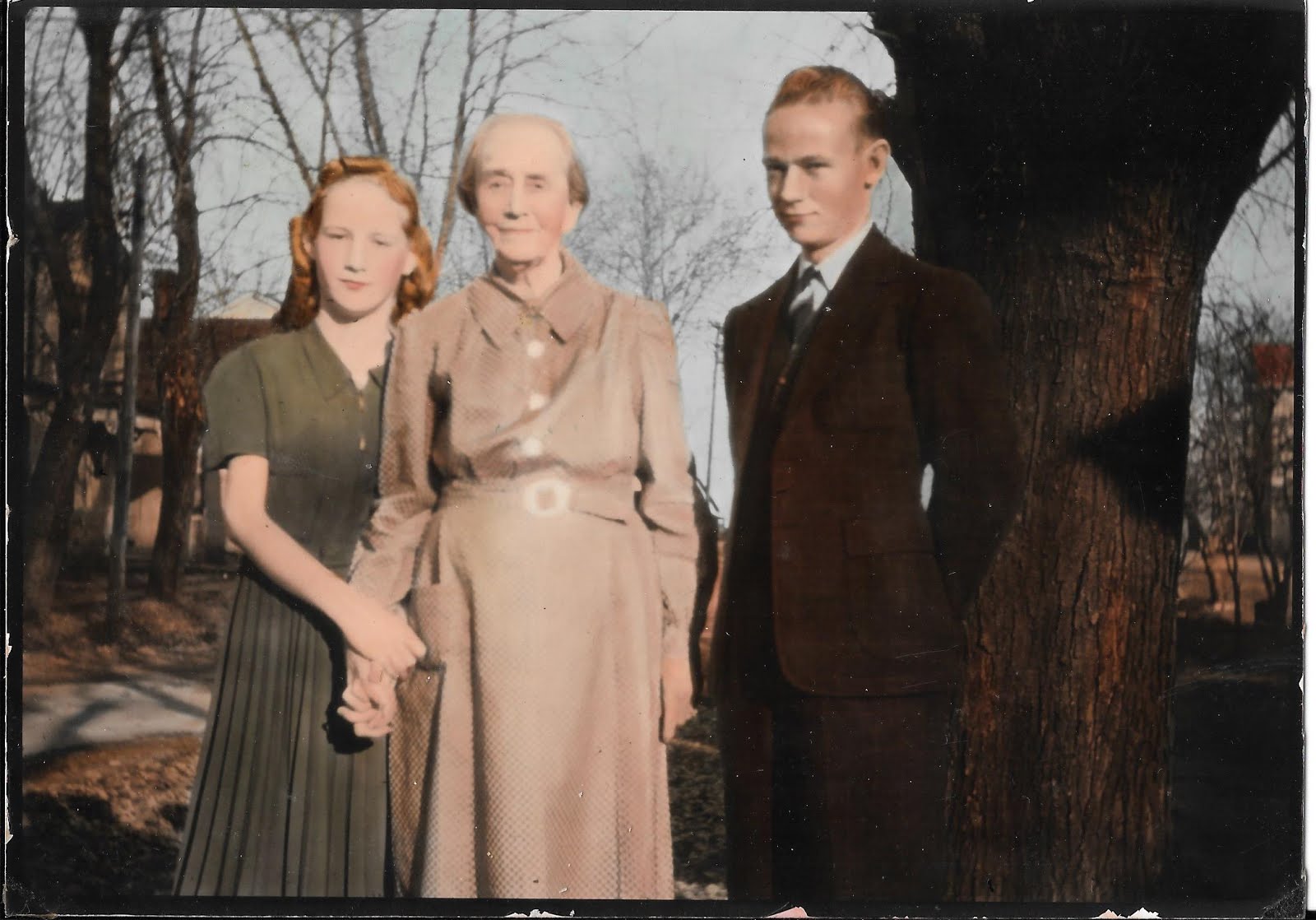
Apparently the photo was a specialty picture of some kind.  I’ve been told it started as a black and white, was colored in and then photographed again.

This picture was apparently taken the same day.  On the left is my mother, Doris Louise Darnell. Just guessing I think she was about 15. I think in the middle is my great grandmother Mrs. Rose A. Darnell, wife of Isaac R. Darnell.  She died in 1941. On the right is Donovan L. Darnell, my uncle. When I was a kid he jokingly called me Jack.  I’m proud to be named for him. ~ Don

More odd Phrases…….

Here’s another list of odd phrases that he collected and found lots of humor in. ~ Don, 1/24/2016
A sign seen in an Owingsville service station”NOT RELIABLE FOR ACCIDENTS!”
– – – – – – – – – – – – – – – – –
Git a hankerin’
As bitter as gall
Pretty as a picture
Hotter than a $2 pistol
Hotter than a firecracker
Bigger than a bear
Meaner than a snake
What’s cookin’?
Hackin’ it
Gone fishin’
Wed backer bed
Young whipper snapper
Punkin’ stud
Middlin’ to skuddlin’
Sharper than a tack

Odd Words and Phrases

The use of proper grammar and correct enunciation were important to Daddy.  His mother, Jane Kincaid, taught for many years, and he taught and worked in the board office for 42 years.  Here is a list of words he wrote down that were local regionalisms. When coming into town one of his favorites was ” we have arroved!” ~ Don
That therin (that)
Hit (it)
His’n, her’n (his or her ownership)
Wed backer beds ( weed tobacco beds)
Hain’t (they ain’t)
Summers (somewhere)
That’s all they are to it.
Sumpin (something)
Agin (against) 
He listed a few sayings as well:
Nip and tuck (thought to be the same as neck to neck as in a race)
Colder than a mackerel (cold and dead)
Darker than pitch. (roof pitch is black)
Madder than a wet hen.
Meaner than a snake.
Hotter than a fire cracker.