"Cap" Dawson’s Blacksmith Shop

In this entry, Mr. Burl writes about the blacksmith shops that were in Owingsville and specifically mentions “Cap” Dawson.  In his book, The History of Bath County, John Adair Richards also mentions Cap Dawson.

From the journals:

Have you ever watched a blacksmith prepare a shoe for shoeing a horse?  All of our Bath County towns had these shops.  A typical blacksmith had an anvil, a forge and bellow, hammers, cutters, barrel of water, and nails.  The “Smithy’s” shop often was crude with a dirt floor.

Before the automobile took its toll on the blacksmith shops in the late twenties, there were three shops in Owingsville.  Do you recall the name of “Cap” Dawson, Wes Harris, and Jim Reed?  “Cap” was the smith for a shop located where Western Auto* now operates.  Later,  “Cap” operated a shop where the E.L. and A.T. Byron building now stands on the corner of Henry and Oberlein Streets (not “Oberline” as is currently on the sign).

Young boys often frequented these shops as spectators enjoying the works of the blacksmiths.  Often there was excitement when an unruly horse acted up. Blacksmiths would on occasion accept other jobs such as repairing hinges, repairing metal parts of farm wagons, etc. 

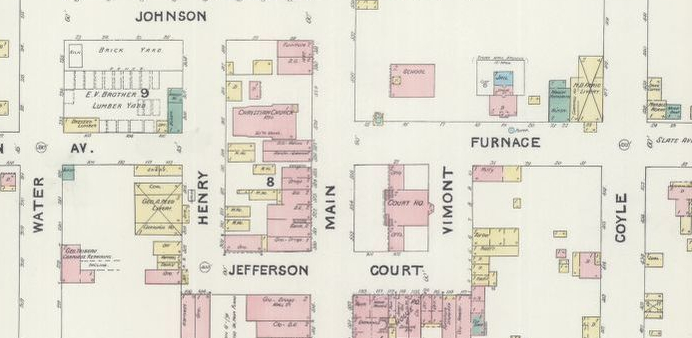
*Western Auto was located where Family Discount Drugs now stands. If you look on the map below, you’ll see a blacksmith shop in that location.

default
Old Sanborn Insurance map of Owingsville, 1891. This map shows a blacksmith shop on the corner of  Oberlin and Water, plus another one by the old jail on Slate Avenue (“Furnace” on the map).  Mr. Burl’s memory of the blacksmith shop would come much later as he wasn’t born until 1916.  Sanborn Fire Insurance Map from Owingsville, Bath County, Kentucky. Sanborn Map Company, Jul, 1891. Map. Retrieved from the Library of Congress, .
sn86069620 1899-04-06 1 4 image 681x648 from 3507x3872 to 5523x5792
News of blacksmiths from an old copy of the Owingsville Outlook dated 1899. Vice on the left column, while John Craig is mentioned on the right. Owingsville outlook. (Owingsville, Ky.), 06 April 1899. Chronicling America: Historic American Newspapers. Lib. of Congress.
sn86069620 1906-05-31 1 1 image 681x648 from 1347x5842 to 3528x7919
News clipping from 1906 that mentions the Wyoming blacksmith. Owingsville outlook. [volume] (Owingsville, Ky.), 31 May 1906. Chronicling America: Historic American Newspapers. Lib. of Congress.

sn86069620 1903-03-05 1 1 image 681x648 from 401x4395 to 2549x6440
Owingsville outlook. [volume] (Owingsville, Ky.), 05 March 1903. Chronicling America: Historic American Newspapers. Lib. of Congress.

sn86069620 1898-10-06 1 1 image 681x648 from 359x4129 to 2363x6038
1898 newspaper clipping mentioning the blacksmith at Preston. Owingsville outlook. [volume] (Owingsville, Ky.), 06 Oct. 1898. Chronicling America: Historic American Newspapers. Lib. of Congress.

Fratman Hall

 
There used to be a place in Owingsville where actors would gather and put on grand performances.  Seriously.
From the journals:
“Chick” is in there selling nuts and bolts, paints and varnishes, and most anything you need in the hardware line but what does that have to do with Fratman Hall?  That’s right – the Smith and Son building was originally an entertainment emporium. 
Mr. Fratman was the owner and manager of the upstairs auditorium.  The rear of the downstairs, which is presently occupied by the Maze Auction Company, housed a circular staircase such as those seen in movies of yesteryear.  The actors and actresses dressed in the rooms at the foot of the stairs and walked up to the stage.
Vaudeville type shows, plays, and other forms of show biz were the order of the day.  Often, young boys would hang around the entrance after the show started, and if the house was not full and the boys were deserving, they were permitted to enter free of charge.
We have a sneaking suspicion that Mr. Burl was one of those boys who would hang around the entrance! 
~Ginger


A clipping from an old Owingsville Outlook (March 10, 1892). A show called “The World” is playing at Fratman Hall and it is mentioned twice in the left column and once in the right.

Brigadier General James Virgil Thompson

Reposting in honor of Memorial Day and for D-Day, which is right around the corner.

An American G.I. untangles communication wires that had become
wrapped around a cross in Pont l’Abbe during the fighting. (Photo from The Library of Congress)
                                           
 June 6th of this year marks the 70th anniversary of D-Day, the day when allied forces stormed the beaches of Normandy during WWII.  Bath County can be proud that many, many men from here answered the call of duty during the Great War, but one in particular stands out because his name can be found in the history books as one who helped lead the charge during the Normandy invasion.  That “one” is James Virgil Thompson, commander of the 358th infantry of the 90th Division of the VII Corps.  The 90th Division bore the nickname “Tough Ombres.”   Mr. Thompson’s brothers were Ed, Bascom, Banks, Earle, and Arnold(1).From the journals:“Excuse me, may I have your autograph, Lt Lindbergh?” asked a person in the crowd.

“I am sorry, but I am not Lt. Lindbergh,” responded Lt. Thompson.

Incidents such as this occurred often.  Charles A. Lindbergh (an international hero) and Virgil Thompson of Owingsville were men of the same stature and their facial expressions were much the same when they smiled.  Lindbergh had just made his historic flight from Garden City, N.J. to an airfield near Paris, France in May of 1927. 

Close to that time, Thompson had graduated from West Point as a 2ndLieutenant.   Charles Lindbergh had been commissioned a 2ndLieutenant in 1925.  The two men were about the same age, looked alike, had that same military bearing, and of course wore army uniforms most of the time.

Lt. Thompson worked his way up through the ranks and it was apparent to those who knew him that he would achieve a high military rank someday.  Virgil served in the Philippine Islands, Panama, and other foreign posts as he climbed from rank to rank.  Finally, after this country was attacked by the Japanese, war was declared by the United States against the Axis powers.

Lt. Thompson became Colonel (Bird Colonel) Virgil Thompson and was a regimental commander.  He led his troops on the beaches of Normandy and was wounded by several machine gun slugs in the abdomen (2)  For many days, it was feared that Virgil would not make it.  Colonel Thompson did recover and returned to the ‘States’ where he was discharged.  He remained as a civilian for a short time, then went back on active duty.

Colonel Thompson was promoted to Brigadier General and went to Korea as an advisor to the South Korean military.  There is no doubt among his friends that Virgil would have risen to perhaps the rank of a Four Star General if he had not been badly wounded in France.

While at West Point, Virgil had the distinct honor of leading the “Army Mule” at an Army-Navy football game.  This was an honor bestowed upon only the top men in the academy. 

Bath Countians saw Virgil on the “Pathe” news at the Majestic Theatre.  Later, a movie starring Richard Dix entitled ‘The Quarterback’ was shown at the local theatre.  The shot of Cadet Thompson leading the mule was cut from the “Pathe” (3) news and inserted in the movie The Quarterback.

Brigadier General Virgil Thompson was a great Bath Countian and American who gave his best for his country.

Virgil seemed to enjoy visiting with people from all walks of life when he would return home on leave.  In the summer when Virgil was at home, he would chat with the boys in the Court House yard and seemed to enjoy it immensely.

(1) Captain Arnold Thompson, a recipient of both the Bronze and Silver Star prior to his death, was killed in Germany during WWII.   At one point he served under General Patton.

(2) In his book Hanging Sam:  A Biography of General Samuel T. Williams, Harold Myer includes this description of the fighting at Pont l’ Abbe, France:  “The 358thInfantry continued its attack on Pont l’ Abbe with the plan of eventually pushing on to occupy the high ground beyond the town. . . The 358th Infantry encountered severe resistance in its sector and was forced to engage the enemy in hedgerow to hedgerow combat.”

(3) Pathé news produced and distributed cinema newsreels.

If you want to read more about Virgil Thompson and his role in the Normandy Invasion, I would suggest searching for “Col. James V. Thompson.”  My good friend Harvey Thompson is the great nephew of Virgil Thompson, and I want to thank both him and his mother, Miss Ada June, for their help in providing me with more information about this great military hero from Bath County.


Members of the 358th infantry attempt to hide an
anti-tank gun in a stack of hay somewhere in the countryside of France. (Photo – Library of Congress)
Soldiers advancing towards Utah Beach during the invasion of Normandy. (Photo – Library of Congress)
A newspaper clipping announcing the death of Arnold Thompson
and the wounding of J.V. (Virgil) Thompson. (Clipping courtesy of the Thompson family.) 
Charles Lindbergh, who does indeed bear
a resemblance to Virgil Thompson. (Photo – Library of Congress)

A Hometown Baseball Legend

f6578-owingsvillegiants
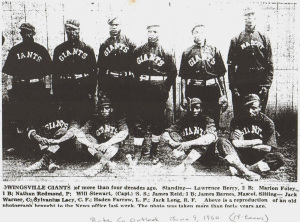
The Owingsville Giants.  Nathan Redmond is third from the left in the back row. Photo courtesy of The Bath County Outlook.

My father-in-law, William Burl Kincaid, Jr., was a huge baseball fan. Well . . . he was more like a fanatic.  Some of my fondest memories are of going with him to watch his beloved St. Louis Cardinals play their exhibition games in Louisville and watching them play their championship games on TV in his living room. This was back in the 1980’s when they boasted such players as Willie McGee and the outstanding Ozzie Smith. There was one hometown player from the 1920’s that he thought ranked right up with these greats. ~ Ginger

From his journals:

Ty Cobb, Walter Johnson, Jackie Robinson, Babe Ruth, Ted Williams, Stan Musial, and Willie Mays. If you love baseball, you have heard of the exploits of these baseball players, but have you heard the name Nathan Redmond?  This man was legend around Owingsville. To begin with, he was endowed with a fine physique.  He stood about six-two and was well proportioned.

Nathan, in his younger days, was noted as a pitcher with a blazing, screaming fast ball. Today, baseball fans would say that he threw “heat.”   Many batters – good hitters – were caught with their bats on their shoulders.  Of some that did swing, it was too late because of the velocity of his pitch.

Nathan, like many pitchers today, unfortunately developed arm trouble and that blaze he had thrown was slowed down.  Being a great hitter (especially of the long ball), Nathan began to play first base and was a standout there.  

The author saw him play many times and on occasions remembers the left-handed batter hitting one that rolled across U.S. 60 from Kimbrough Park.*

Had Nathan Redmond lived now or in recent years, those who remember him feel that he would have starred as a big leaguer.  In his day, Nathan could not have been a National League or American League player because of his color.

Some of you remember the men who played with Nathan.  To name a few – Jim Reid, Jerry Lacy, Bob Foley, Dusty Stewart, Diner Gray, and Lawrence Berry. **

* Kimbrough Park was located in the vicinity where the Southern States lot is and across from Steve Butcher’s car lot on U.S. 60 East.

**I’m not completely sure the names Dusty and Diner are correct as those words are difficult to make out in the text. If they are wrong, please make a comment or drop me a note.

sn85038022 1921-07-18 1 1 image 681x648 from 973x3401 to 2807x5148
A news clipping from July 18, 1921 edition of  The Public Ledger (Maysville, Ky). Image courtesy of the University of Kentucky via The Library of Congress.

The Owingsville Panthers

From the journals about a basketball team that he played on. He and his teammates would have been between 18 and 21.

Prior to the 1935-36 basketball season, a group of young men organized a semi pro team. After much discussion regarding organization, uniforms, transportation, finances, and team name, it was apparent from our first talks that we would like a name not being used much in our area so we chose the name “Panthers.”  Having attractive, colorful uniforms required much input from the squad members. Finally, we selected crimson and gray (Ohio State University colors) which made a very striking outfit.  Our warm-up jackets were crimson with gray sleeves and they had a Panther head to the left on the chest.  Fortunately, we knew Roy Kissick who was the proud owner of a huge Cadillac(with jump seats) and would transport our team. On occasions he would crowd 13 in that fine car.

The Panthers scheduled several independent or semi-pro teams in this area, such as Paris, Camargo, Morehead CCC, Carlisle, Little Rock and others.  We won more than half of the games we played.

The Panther Squad

Coach Morgan Steele

Players:
John H. Elliott
Roger Byron
Burl Kincaid Jr.
Harold Reynolds
Charles Hazelrigg
Charlie McKee
Charles Anderson
“Dinks” Jones


TV in 1934? A Trip to the Chicago World’s Fair.

By Weimer Pursell, silkscreen print by Neely Printing Co., Chicago – This image is available from the United States Library of Congress

From Daddy’s notes on the 1933-1934 Chicago World’s Fair:

What is Television? Who are you trying to kid? Projecting a picture and sound through the atmosphere? No, we believe this to be some kind of joke!  Well, let’s go in and see about this thing called television.

Five young Owingsville men, after hearing all the glowing remarks about the Chicago World’s Fair(also known as “A Century of Progress”), decided to journey to this big city. The young men were, Richart Brother, Bronson Snedegar, Burl Kincaid Jr., John H. Elliott, and Theodore Crouch. Theodore was older than the others and owned an automobile, so the other four supplied the gas and oil. Off and away they went to a week of fun and education. 

    
This was in 1934 which was in the heart of the so called “Great Depression.”  For those of you who do not remember that era, there was little money in the United States. Many families found themselves with every member unemployed. If you did not live during those years, there is no way that you can imagine what some fellas lived through.  

Upon entering the building which was built for the display of this new media called “television,” we were surprised at the shape of the auditorium or theatre (we did not know what to call it). The building was narrowly rectangular with a telecasting booth in one end and a large TV screen in the other. The large center section had seating much like movie theatres. Since it has been some 60 years since being privileged to witness a great electronic device being publicly born, the writer does not have much idea as to the number of seats. 


The young men were seated together and were anxious for the program to start. The announcer made some glowing remarks about the fair in general and TV in particular. A program was presented (do not remember much about it) but the presenters were concerned that the audience might think the whole thing could be a fake. To dispel any thought of the presentation on the screen being a fake, a person surveyed the audience and asked certain persons to go to the telecast booth. It seemed that he chose one person from each group. The writer was chosen from our group and got to be on television!

Daddy spoke of this trip often. He and others were only eighteen years old. He brought back the official book from the fair and we still have it.

His favorite area was the Little Town. It was an exhibit of everything small, with an entire home and its furnishings built on a small scale, but still big enough to enter and walk around.  ~ Don Kincaid

A participation card from the television exhibit at the Chicago World’s Fair. Image courtesy of https://www.earlytelevision.org/chicago_1933_worlds_fair.html

For more information about the Chicago World’s Fair of 1933-1934, you can visit the following links:

https://en.wikipedia.org/wiki/Century_of_Progress

https://www.earlytelevision.org/chicago_1933_worlds_fair.html

Minihan Saddles

From Daddy’s notes:

Bath County at one time produced some of the finest saddles obtainable.  The saddles were custom made to fit the individual. There are today some of those saddles still around.  Doris Darnell Kincaid owns one of those prized saddles as do some other Bath Countians.


Eugene Minihan founded and operated the saddlery business in O’ville.  He surround himself with several skilled employees and produced the renowned Minihan saddles. His shop was located where Dr. D.C. Cameron now has his office on the west side of Jefferson St. 


Mr. Minihan only made saddles for the individual, in other words, tailor made. The finest leather was used and the workmanship was excellent.  Great pride was taken in the comfort and fit built into the saddles.  

The author has one of the small anvils used by Mr. Minihan in the making of his fine saddles.

After 50 years of the Minihan saddle hanging in a hot garage, my mom sold the saddle to a collector in Cynthiana.  He cleaned and repaired the saddle and it is on display in his workshop. 


From the internet about Minihan:

“Eugene Minihan is credited with originating the “Kentucky Springseat” saddle. Mr. Minihan made these saddles in his shop in Owingsville, KY from the late 1880s to the time of his death in 1926. Many knowledgeable horsemen consider them the finest riding saddle ever. Minihan took a standard Somerset Broad Cantle saddle tree and removed the center of the tree bars, then spliced in pieces of stiff leather to make a sort of “hinge”. This was the first, and most successful, flexible tree design. It is very labor intensive to construct, and new saddle trees of this type are not commercially available. Original Minihans are highly prized, and several skilled saddle makers rebuild them on the original trees.”

Don


Letter to the Herald-Leader about Frank Jones


Mike Fields, Staff Writer
Lexington Herald-Leader Co.
100 Midland Avenue
Lexington, KY 40508

Sir,

Read your column Friday 19th and noted your piece about Jeremy Simpson and Mark Higgs.

In 1969, Bath County had a great running back-Frank Jones.  Frank was the leading scorer in Kentucky high school football that year.  Jones scored 38 TDs and 22PATs for a total of 250 points.

Jones rushed for a total of 3,361 yards in 327 carries in 1969.  Frank’s average per carry was 10.24 yards.

The above statistics ware taken from the Nov. 13, 1969 Louisville Courier-Journal.

Also, Frank Jones is the all-time rushing leader for Morehead State University.

Am enclosing a copy of the Courier-Journal article from which the above statistics were taken.

Yours for good sports,

W. Burl Kincaid, Jr.
Owingsville, Ky

Jones still holds the record he set in 1969 for rushing a total of 3,361 yards.  
Official records of this can be found at KHSAA internet link below.  Don

http://khsaa.org/records/football/individualrecords.pdf

Sitting Up With The Dead


Funeral notice from 1935.  It opens up but is blank inside.
From the journals:
A discussion of funerals can be a morbid subject, but let us look into how funerals and the preparation for such rites were treated in Bath County prior to the advent of funeral homes.
Upon notification of the undertaker, the body of the deceased was taken to the undertaker’s place of business (which was not a funeral home) and embalmed.  The body was then returned to the home or church to await burial.  It was customary for the mortician to have funeral notices printed out and distributed, mostly to places of business.   Funeral notices usually gave the name, date of birth, place of burial, date and time of the service, and the pall bearers.  In some cases, active and honorary pall bearers were listed separately.  Usually, the notice was edged in black, but like other things, this changed from time to time.
It was a custom for friends and neighbors to ‘sit up’ with the corpse, and most people insisted that the body of the deceased be attended at all times.  Many of you reading this have probably ‘sat up’ with the body of someone.
Customs in any kind of life event change.  Perhaps strain, sadness and anxiety have been relieved somewhat by our modern funeral homes.  The author vividly recalls ‘sitting up’ with the body of a friend whose life had been suddenly snuffed out by an auto accident.  The corpse was a beautiful young lady whose body had been mangled by the accident. Of course, the body was at her home and the young lady’s mother, father, sister, and brother were there.   You can imagine what such a night would be like – heart rending and such a helpless feeling overall.
On her blog Adventures in Cemetery Hopping, Traci Rylands offers a nice overview of the practice of “sitting up with the dead,” as well as other Southern traditions surrounding funerals.