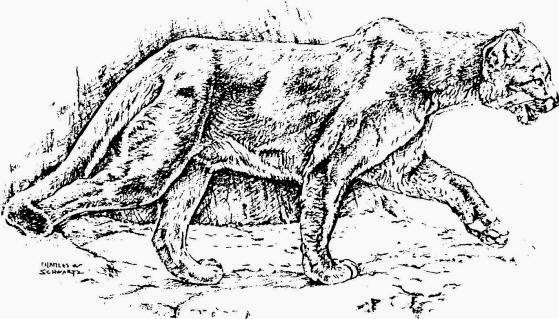
An illustration of a catamount, also known as a cougar, puma, mountain lion, or “mountain screamer.” They can be the size of a full-grown man. Photo courtesy of the Library of Congress.
This is one of our family favorites, and we hope you enjoy it too. Mr. Burl’s grandfather, Jacob Kincaid, lived at Stepstone until he moved to town around 1900, give or take a few years. The best we can figure is that this catamount hunt at Stepstone took place in the latter decades of the 1800’s.
From the journals:
“Most all children love to have parents or grandparents relate unusual tales to them. Perhaps this is something the children of today do not have enough exposure to. What follows is a tale my grandfather used to tell me.
A predator of some sort was killing and maiming the livestock in the Stepstone community years ago. The slaughter of small livestock reached such a magnitude that men of the area would ride through the pastures and woods searching for the culprit. Some of the riders carried rifles and some carried shotguns. The search went on for several weeks with no progress.
One day, “Jake” Kincaid and a Mr. Utterback were riding through a wooded area when suddenly from behind an old log a ferocious animal sprang up on his hind legs. The animal let out a blood-curdling scream. The two men were almost overcome with “buck fever,” but both got off a shot at the wild creature. Both men thought they had dealt the fatal blow. Kincaid and Utterback, seeing the cat was dead, eased closer and closer to determine what their victim was.
The two friends later decided that it was a large “catamount.” Folks in the community that had seen such animals before supplied the name. A catamount goes by other names depending upon the section of the continent where it is found. Other names for this member of the cat family are panther and puma.
The Stepstone community rejoiced because the slaughtering of their small animals would and did pass. Mr. Utterback volunteered to take the big “cat” home and skin it and this tale ends there.”
That tale does end there but mine is not quite finished!
Catamounts are mentioned frequently in old newspaper clippings from around the time period of the Stepstone incident. The January 5, 1899 issue of the Owingsville Outlook states that a Chas. Skeins caught a catamount Sunday night at his home near here. This was in the Hillsboro section of the paper.
Additionally, in the February 2, 1892 issue of the Mt. Sterling Advocate, this report is given of the killing of a catamount: Two grown sons of Jerry Carpenter, living near Daisy Dell, in this county, killed a catamount recently so large that when they tied its hind feet together and suspended it on a pole between them, its head dragged the ground. After they shot it through the body it whipped their dogs and they had to kill it with an ax.
Is this all past history? Are the catamounts gone from the wild forever here in our neck of the woods? Well, maybe not. Folks still claim to see the big cats from time to time. ~ Ginger

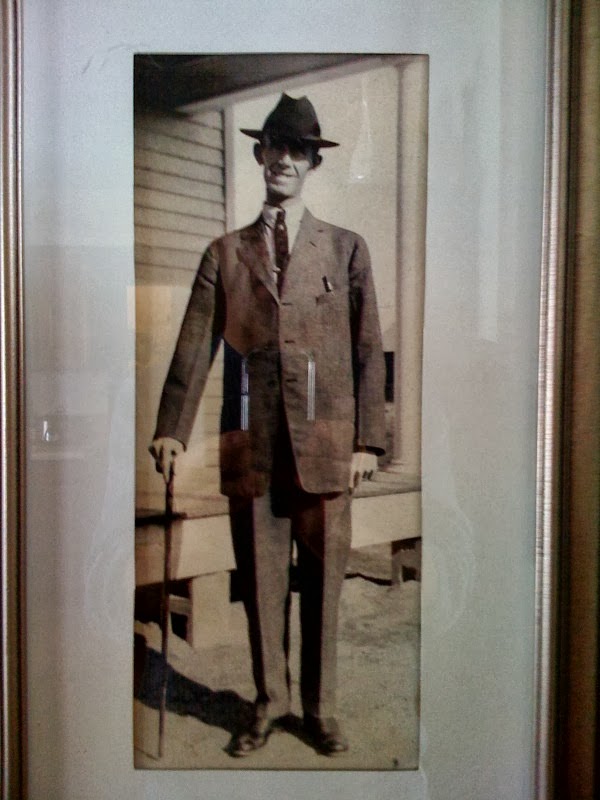
 From the Journals of William Burl Kincaid, Jr.