"Cap" Dawson’s Blacksmith Shop

In this entry, Mr. Burl writes about the blacksmith shops that were in Owingsville and specifically mentions “Cap” Dawson.  In his book, The History of Bath County, John Adair Richards also mentions Cap Dawson.

From the journals:

Have you ever watched a blacksmith prepare a shoe for shoeing a horse?  All of our Bath County towns had these shops.  A typical blacksmith had an anvil, a forge and bellow, hammers, cutters, barrel of water, and nails.  The “Smithy’s” shop often was crude with a dirt floor.

Before the automobile took its toll on the blacksmith shops in the late twenties, there were three shops in Owingsville.  Do you recall the name of “Cap” Dawson, Wes Harris, and Jim Reed?  “Cap” was the smith for a shop located where Western Auto* now operates.  Later,  “Cap” operated a shop where the E.L. and A.T. Byron building now stands on the corner of Henry and Oberlein Streets (not “Oberline” as is currently on the sign).

Young boys often frequented these shops as spectators enjoying the works of the blacksmiths.  Often there was excitement when an unruly horse acted up. Blacksmiths would on occasion accept other jobs such as repairing hinges, repairing metal parts of farm wagons, etc. 

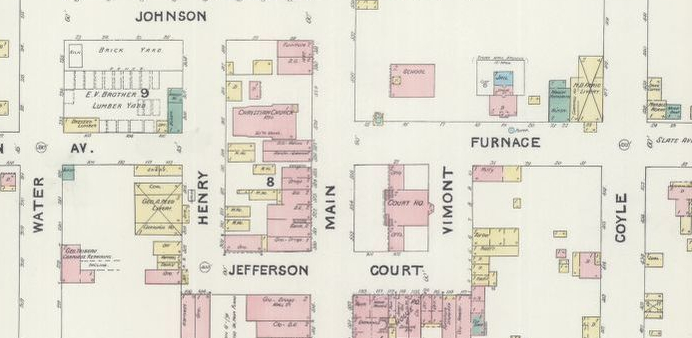
*Western Auto was located where Family Discount Drugs now stands. If you look on the map below, you’ll see a blacksmith shop in that location.

default
Old Sanborn Insurance map of Owingsville, 1891. This map shows a blacksmith shop on the corner of  Oberlin and Water, plus another one by the old jail on Slate Avenue (“Furnace” on the map).  Mr. Burl’s memory of the blacksmith shop would come much later as he wasn’t born until 1916.  Sanborn Fire Insurance Map from Owingsville, Bath County, Kentucky. Sanborn Map Company, Jul, 1891. Map. Retrieved from the Library of Congress, .
sn86069620 1899-04-06 1 4 image 681x648 from 3507x3872 to 5523x5792
News of blacksmiths from an old copy of the Owingsville Outlook dated 1899. Vice on the left column, while John Craig is mentioned on the right. Owingsville outlook. (Owingsville, Ky.), 06 April 1899. Chronicling America: Historic American Newspapers. Lib. of Congress.
sn86069620 1906-05-31 1 1 image 681x648 from 1347x5842 to 3528x7919
News clipping from 1906 that mentions the Wyoming blacksmith. Owingsville outlook. [volume] (Owingsville, Ky.), 31 May 1906. Chronicling America: Historic American Newspapers. Lib. of Congress.

sn86069620 1903-03-05 1 1 image 681x648 from 401x4395 to 2549x6440
Owingsville outlook. [volume] (Owingsville, Ky.), 05 March 1903. Chronicling America: Historic American Newspapers. Lib. of Congress.

sn86069620 1898-10-06 1 1 image 681x648 from 359x4129 to 2363x6038
1898 newspaper clipping mentioning the blacksmith at Preston. Owingsville outlook. [volume] (Owingsville, Ky.), 06 Oct. 1898. Chronicling America: Historic American Newspapers. Lib. of Congress.

A Hometown Baseball Legend

f6578-owingsvillegiants
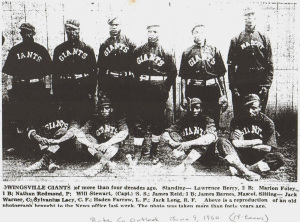
The Owingsville Giants.  Nathan Redmond is third from the left in the back row. Photo courtesy of The Bath County Outlook.

My father-in-law, William Burl Kincaid, Jr., was a huge baseball fan. Well . . . he was more like a fanatic.  Some of my fondest memories are of going with him to watch his beloved St. Louis Cardinals play their exhibition games in Louisville and watching them play their championship games on TV in his living room. This was back in the 1980’s when they boasted such players as Willie McGee and the outstanding Ozzie Smith. There was one hometown player from the 1920’s that he thought ranked right up with these greats. ~ Ginger

From his journals:

Ty Cobb, Walter Johnson, Jackie Robinson, Babe Ruth, Ted Williams, Stan Musial, and Willie Mays. If you love baseball, you have heard of the exploits of these baseball players, but have you heard the name Nathan Redmond?  This man was legend around Owingsville. To begin with, he was endowed with a fine physique.  He stood about six-two and was well proportioned.

Nathan, in his younger days, was noted as a pitcher with a blazing, screaming fast ball. Today, baseball fans would say that he threw “heat.”   Many batters – good hitters – were caught with their bats on their shoulders.  Of some that did swing, it was too late because of the velocity of his pitch.

Nathan, like many pitchers today, unfortunately developed arm trouble and that blaze he had thrown was slowed down.  Being a great hitter (especially of the long ball), Nathan began to play first base and was a standout there.  

The author saw him play many times and on occasions remembers the left-handed batter hitting one that rolled across U.S. 60 from Kimbrough Park.*

Had Nathan Redmond lived now or in recent years, those who remember him feel that he would have starred as a big leaguer.  In his day, Nathan could not have been a National League or American League player because of his color.

Some of you remember the men who played with Nathan.  To name a few – Jim Reid, Jerry Lacy, Bob Foley, Dusty Stewart, Diner Gray, and Lawrence Berry. **

* Kimbrough Park was located in the vicinity where the Southern States lot is and across from Steve Butcher’s car lot on U.S. 60 East.

**I’m not completely sure the names Dusty and Diner are correct as those words are difficult to make out in the text. If they are wrong, please make a comment or drop me a note.

sn85038022 1921-07-18 1 1 image 681x648 from 973x3401 to 2807x5148
A news clipping from July 18, 1921 edition of  The Public Ledger (Maysville, Ky). Image courtesy of the University of Kentucky via The Library of Congress.

Letter to the Herald-Leader about Frank Jones


Mike Fields, Staff Writer
Lexington Herald-Leader Co.
100 Midland Avenue
Lexington, KY 40508

Sir,

Read your column Friday 19th and noted your piece about Jeremy Simpson and Mark Higgs.

In 1969, Bath County had a great running back-Frank Jones.  Frank was the leading scorer in Kentucky high school football that year.  Jones scored 38 TDs and 22PATs for a total of 250 points.

Jones rushed for a total of 3,361 yards in 327 carries in 1969.  Frank’s average per carry was 10.24 yards.

The above statistics ware taken from the Nov. 13, 1969 Louisville Courier-Journal.

Also, Frank Jones is the all-time rushing leader for Morehead State University.

Am enclosing a copy of the Courier-Journal article from which the above statistics were taken.

Yours for good sports,

W. Burl Kincaid, Jr.
Owingsville, Ky

Jones still holds the record he set in 1969 for rushing a total of 3,361 yards.  
Official records of this can be found at KHSAA internet link below.  Don

http://khsaa.org/records/football/individualrecords.pdf

Will Hayden’s Roofs


Annie Hayden, wife of Will Hayden, circa 1953.  “Miss Annie” worked for the Jacob Kincaid family and can be seen in numerous family pictures. This picture was taken in the back yard of what is now Marcelle Doggett’s home. Some say there is the image of a ghost in the lower right hand side of the picture, right under Miss Annie’s left hand.  
 
If you make it a point to observe some of the tin roofs in Bath County, you will note that there is a type with ridges, where sheets of tin have been crimped together.  These tin roofs were installed by a master tinner.  This tinner was a resident of Bath County, and his name was Will Hayden.  He had his shop in the building that he owned on the corner of Oberlin and Water Streets.  The red building still stands at that address.*
Many houses and businesses are still sheltered by the tin roofs installed by Mr. Hayden.
*The red building that Mr. Burl refers to is no longer standing, as it was destroyed by fire several years ago.  However,  Mr. Hayden’s roofs are still visible all over town.   Don and I took a drive on a Sunday not too long ago, and he showed me several examples of this skilled tinner’s work.  You can differentiate between newer metal roofs and those installed by Mr. Hayden by looking for staggered, horizontal overlaps.  Some of the houses in town are completely covered by his metal roofs, while others just have the original porch overhang.   The overhang on Mr. Delbert Anderson’s home is an example of Mr. Hayden’s fine craftsmanship.  Once you know what to look for, the roofs become easy to spot.

Johnny White’s Hamburgers

I’m a hamburger traditionalist:  I like them fixed the old fashioned way, with no “modern” toppings like mushrooms, Swiss cheese, or jalapeno peppers,  which is why I think I probably would have loved Johnny White’s. ~ Ginger
 
From the journals:
     Should you ask an old-timer in Bath County, especially in Owingsville, about the best hamburger he ever tasted, the answer would almost invariably be “Johnny White’s hamburgers.”  It has been told that he dipped them in meal and fried them in suet.  At any rate, they were scrumptious and delectable and almost any other adjective meaning great that you can think of.
     Another man who was also noted for his hamburgers in Owingsville was Bob Foley.  Bob had his stand usually either on Henry or Oberlin Street.  Johnny White’s stand was usually on Oberlin Street.
     The stands of these hamburger specialists were small and could be moved without much trouble.  The fronts were structured so that the front side would lift up and be propped up, revealing a counter ledge. Inside would be a coal oil stove which furnished the necessary heat for cooking and enough room for two people to work.
     These hamburger men did not use buns but light bread.  It was not uncommon for one person to buy five to ten at a time.   The price for these delicacies was for many years all of ten cents, but they went up to fifteen cents after World War II.     Another business that was good for the businessman and great for the public has faded from the local scene.